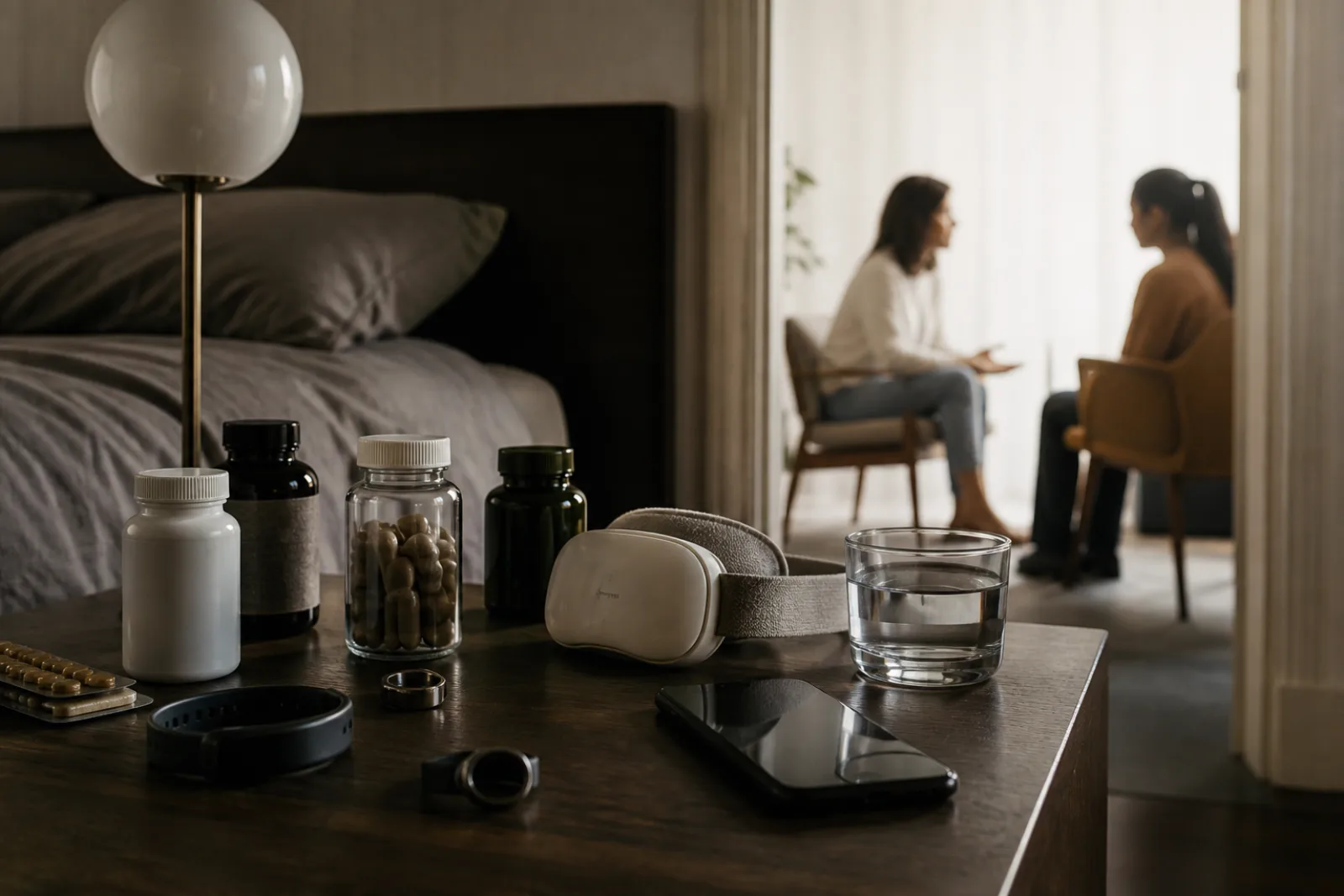
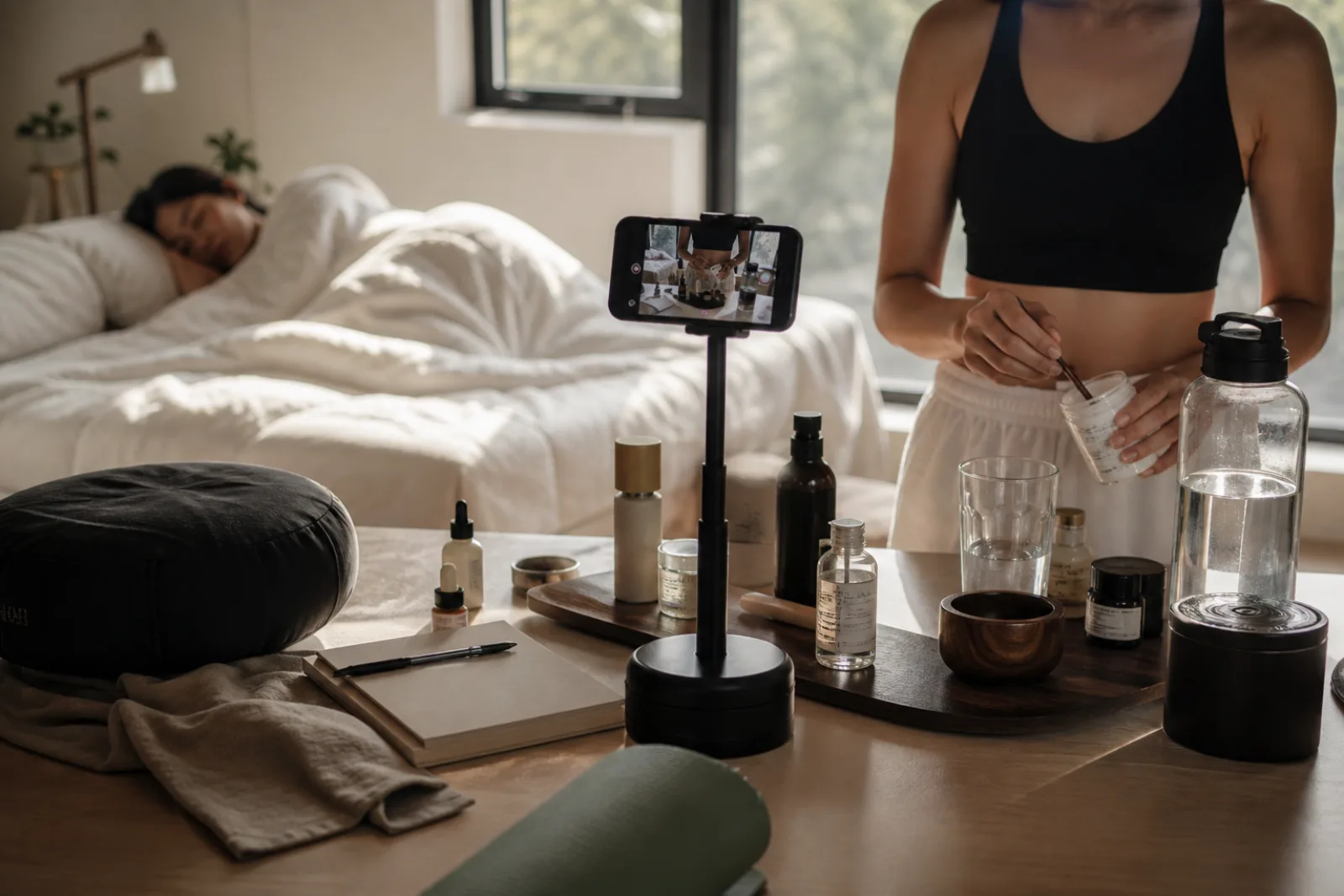
A 5am wake-up, a made bed, a glass of water with lemon, a habit-tracker app opened and checked off, a supplement stack lined up on the counter, ten minutes of journaling, a walk before the sun is fully up, a sunrise alarm clock that faded the room from dark to gold over twenty minutes. None of that is a routine anymore in the old sense of a private habit nobody else sees. It is a shot list. The modern morning is now something you can buy pieces of: an app subscription, a $170 light-based alarm clock, a labeled supplement stack, a wearable ring that scores how well you did the night before you even get out of bed.
What changed is not that people started caring about mornings. It's that the morning became a genre, filmable in short clips, productizable in individual steps, and monetizable through affiliate links and brand partnerships, at the exact moment sleep researchers were converging on a duller, harder-to-sell finding: the specific hour you wake up matters far less than whether you wake up at roughly the same hour every day, and the cheapest lever on how a morning feels is largely just light exposure and a fixed schedule, not a purchase.
What changed
Sleep science still credits a consistent schedule and timed light exposure.
Habit apps and sunrise clocks are filmable. The two variables that move mornings mostly are not.
The trend is not a fringe internet artifact. Robin Sharma's self-help book "The 5am Club" was published in 2018 and mostly stayed in the productivity-book aisle until TikTok picked it up in 2021, turning it into a recurring content format rather than a one-time bestseller. It has cycled back into virality repeatedly since, most recently in 2025, when 5am-wake-up content drew more than 84 million views on the platform under that hashtag alone. Alongside it, the pandemic-era "That Girl" aesthetic, built around an early wake-up, a plant-based breakfast, a workout, and a goal-setting ritual shot in soft light in a spotless kitchen, established the visual template that GRWM-style morning videos still follow.
The market built underneath that content is measurable, if imprecisely. Industry market-research estimates put the global habit-tracking app category at roughly $13 billion in 2025, with US-specific estimates around $5.8 billion the same year. Those figures come from market-research firms rather than audited company filings, so they should be read as directional rather than exact, but the adoption figures line up with what is visible on any given phone's App Store charts: more than 65 percent of US adults report actively monitoring some daily routine through a tracker, and adult engagement with these apps reportedly rose 48 percent in a single year, alongside a 42 percent rise in corporate wellness programs adopting the same tools. Wearable integration is part of the same story: global smartwatch and fitness-tracker shipments passed 220 million units in 2024 and are projected to reach 310 million by 2027, much of that growth pitched specifically around sleep and "morning readiness" scores.
The morning routine as recurring content format
- 2018"The 5am Club" is published
Robin Sharma's self-help book popularizes the 5am wake-up as a specific, brandable hour, distinct from any particular finding about that hour's biological significance.
- 2020 to 2022"That Girl" and pandemic routine content
Lockdown-era TikTok formalizes the aesthetic: early wake-up, made bed, workout, plant-based breakfast, journaling, shot in a curated, minimalist space. Critics note the format overwhelmingly features slim, conventionally attractive, financially comfortable women.
- 2023 to 2025Habit-tracker and wearable market expansion
App-based habit tracking and wearable sleep scoring scale into an estimated multi-billion-dollar category, with wearable shipments surpassing 220 million units in 2024 as sleep and morning-readiness scores become standard features.
- 20255am Club content resurges
The original 2018 book's premise recirculates on TikTok as short-form content, drawing over 84 million views under the associated hashtag, seven years after publication and independent of any new sleep research prompting it.
NationalWorld, Luxiders Magazine, and Market Research Future, as cited in sources.
The mechanism connecting the content boom to the product boom is straightforward and worth naming directly, because it explains why the marketed version of a morning routine looks nothing like what sleep researchers actually recommend. A wake-up hour is a number you can put in a video title. A supplement stack is a product shot. A tracker app streak is a screenshot. A sunrise alarm clock is a physical object with a price tag and an affiliate link. None of that requires any claim to be checked against outcomes data before it can be sold; it only requires that it be visually legible in fifteen to sixty seconds. A consistent bedtime, by contrast, produces no image. It is an absence of variation, which is exactly the kind of thing that does not translate into content, cannot carry a brand partnership, and has no natural price point.
That asymmetry has a second-order effect: creators and brands are incentivized to sell the parts of a routine that are visible and swappable (the specific hour, the specific product) rather than the part that the research says is actually doing the work (the schedule's consistency, which by definition can't be demonstrated in a single video, only tracked over weeks nobody is filming). Corporate wellness programs adopting habit-tracking software at a reported 42 percent higher rate reflect the same incentive at an institutional scale: it is easier for an employer to purchase and roll out a tracking tool than to change the working hours, commute times, or shift schedules that actually determine whether an employee's sleep timing is regular.
| Marketed as the fix | What sleep research actually finds |
|---|---|
| A specific wake-up hour (5am, popularized by branded content) | Consistency of wake-up time day to day, not any particular hour; the National Sleep Foundation's 2023 consensus statement found regular timing correlated with better metabolic and cardiovascular outcomes independent of what hour was chosen |
| A purchased product stack: trackers, supplements, journals, sunrise alarm clocks | Two largely free interventions with the strongest evidence behind them: a fixed sleep and wake schedule, and morning light exposure, which CDC guidance describes as the trigger for the retina to set the day's circadian hormonal timing |
| A visually documented, performed routine (GRWM-style video, streak screenshot) | An unfilmable behavioral pattern sustained over weeks; the health associations in sleep-regularity research are measured over tracked periods, not single mornings |
| Habit-tracker adoption as evidence of behavior change (65 percent of US adults report using one) | Reported 30-day dropout above 52 percent for tracker users, meaning adoption of the tool and durable change in the underlying schedule are two different, frequently uncorrelated things |
Who benefits from that gap is easy to trace. App makers earn subscription revenue regardless of whether a user's sleep timing actually stabilizes; the same market research citing 65 percent tracker adoption also reports over half of users quitting within a month, which is a retention problem for the app but not necessarily evidence the underlying behavior failed; plenty of people internalize a schedule without the app after establishing it. Supplement and wearable brands benefit from the same visibility bias: a product that can be photographed and reviewed draws far more marketing spend and affiliate revenue than a claim about bedtime consistency, which cannot be reviewed as a product because it isn't one. Creators earn from the format itself, since a 5am-wake-up video reliably outperforms an explainer about circadian regularity because it has a clear before-and-after shape.
Who is worse off is a smaller but real group: people who adopt an aggressive early wake-up time as the headline change without correspondingly moving their bedtime earlier, which produces the opposite of what the routine is meant to fix. That risk sits directly on top of an existing shortfall. CDC's 2024 National Health Interview Survey data found 30.5 percent of US adults already averaging less than 7 hours of sleep a night, the threshold the American Academy of Sleep Medicine sets as a minimum for adults. A wake-up-hour aesthetic layered onto an already under-slept population, without the matching bedtime shift the aesthetic rarely shows, can turn a wellness routine into a sleep-restriction routine with better lighting.
“Consistency of sleep onset and offset timing is important for health, safety, and performance.
National Sleep Foundation Sleep Timing and Variability Panel, 2023 consensus statement
What this reveals about consumer behavior is not that people are gullible or that wellness culture is uniquely cynical. It is a recognizable pattern in how markets form around health advice generally: the visible symptoms of good behavior get productized because they can be, while the underlying behavior that actually produces the outcome stays free and undersold because there is no unit to sell. The same pattern shows up in nutrition (supplements outsell the advice to eat consistent meals), in fitness (branded programs outsell the advice to just move regularly), and now in sleep, where the National Sleep Foundation's own consensus statement, the most direct evidence available on what a morning routine should actually protect, has nothing to sell and correspondingly little presence in the content that claims to be built on "the science."
What actually changed
- 01
The morning routine did not become more scientifically grounded; it became more filmable and more product-embeddable, and those are different things that happened to arrive together.
- 02
The single most-cited finding in current sleep research, that timing consistency matters more than any specific wake hour, has no product attached to it and correspondingly little visibility in routine content.
- 03
Market growth in trackers and wearables measures adoption and engagement, not durable behavior change; the same industry data reporting high adoption also reports high 30-day abandonment.
Questions
- 01Does waking up at 5am actually make people more productive or is that just a marketing hook?
There is no research establishing 5am specifically as a biologically superior wake time. The National Sleep Foundation's 2023 consensus statement points to consistency of wake time, not a specific hour, as the factor associated with better health and performance outcomes. A 5am wake-up only helps if it is paired with a correspondingly earlier, and consistent, bedtime; without that, it functions as sleep restriction.
- 02If trackers and morning-routine apps don't reliably change behavior, why do so many people use them?
Adoption and durable change are different metrics. Roughly two-thirds of US adults report using some form of routine or habit tracker, but industry data also shows more than half discontinuing use within 30 days. The tools can help some people establish a schedule, but the high dropout rate suggests the app itself is not the mechanism doing the work; consistent scheduling is, and the tools do not always outlast the novelty of adopting them.