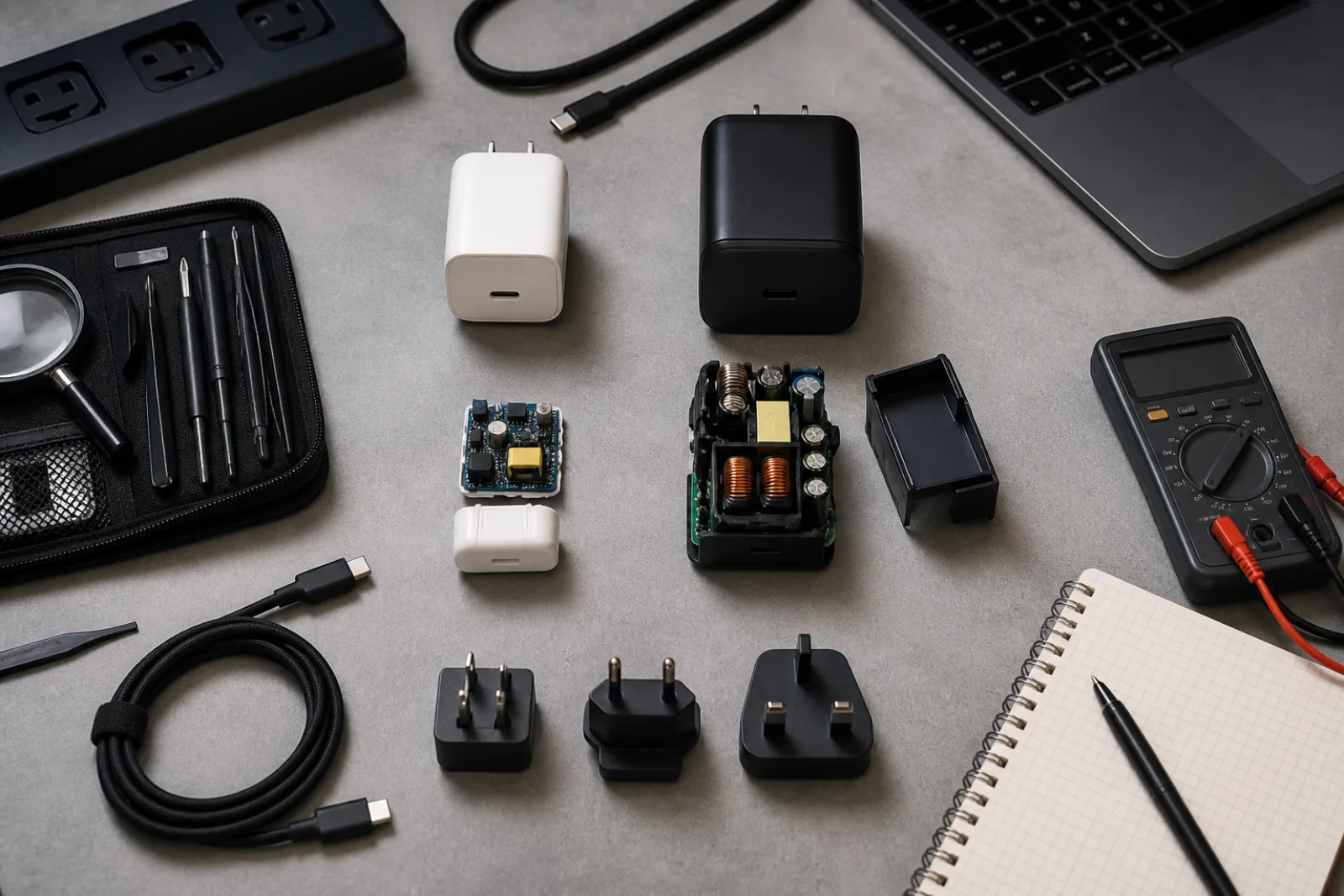
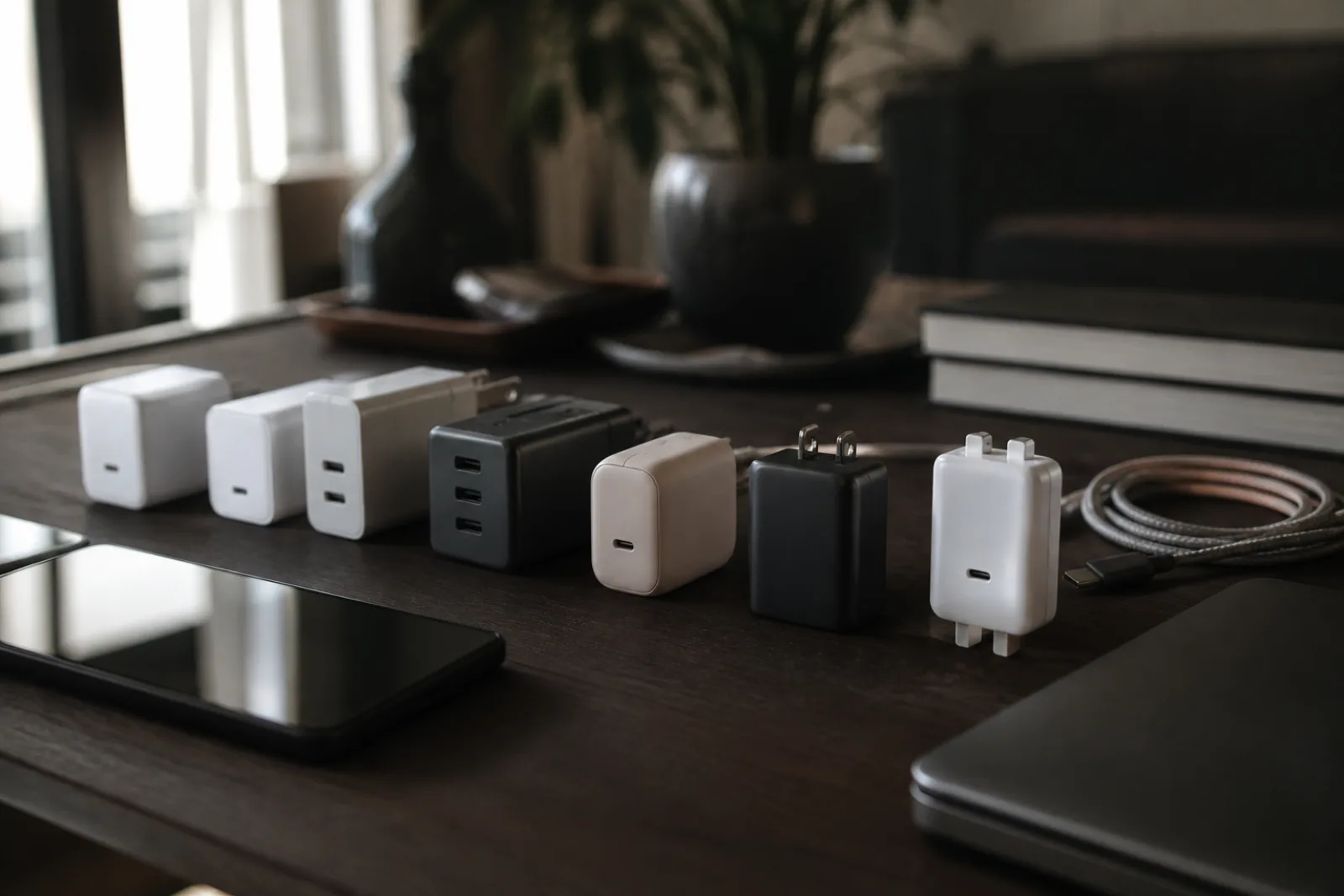
A charger used to be a shape. Nokia had a fat barrel. Motorola had another. Apple had a wide dock, then a skinny one, then a lightning tip that was also a proprietary argument. You could tell whose brick you were holding. USB-C ended that as a visual fact. The port is a flattened oval. The cable looks like every other cable. The wall wart, if it is doing its job, is a silent rectangle. Once the object stopped announcing the brand with a unique plug, something else had to do the announcing: size, finish, the number of ports, and a three-letter semiconductor acronym printed on the box.
This is not a buying guide for Power Delivery profiles. Culture Column's USB-C charger guide covers negotiated wattage, e-marked cables, and safety marks. This is the cultural story sitting on top of that substrate: why a $20 brick became an $80 object of taste, and why GaN, a real materials change, got asked to do the work of a personality. The short version of the status layer is that once every phone in a cafe had the same port, the remaining way to look like you understood charging was to own a small, dark, many-ported object and to say GaN out loud. Understanding charging, in the USB-IF sense, is a test report. Saying GaN is a shibboleth.
What changed
Wattage was printed. The adapter was a utility, not a photograph.
USB-C made every brick look related. Finish and size started standing in for a test report most buyers never see.
The European Commission spent a decade trying to make the drawer less stupid. In 2021, proposing what became the common-charger rules, it said consumers owned around three mobile-phone chargers and used two, that 38 percent had been unable to charge because of incompatible hardware, that Europeans spent about 2.4 billion euros a year on standalone chargers, and that discarded and unused chargers amounted to about 11,000 tonnes of e-waste a year. Directive (EU) 2022/2380, applied to phones, tablets, cameras, headphones, e-readers, and a list of other portables from 28 December 2024, and to laptops from 28 April 2026, made USB-C the required wired receptacle and required USB Power Delivery for devices that charge above 15 watts. The Commission's December 2024 explainer still used the 11,000-tonne figure and estimated 250 million euros a year saved by buying devices without a new brick. That is a policy success about ports. It is also the moment every charger started to look like a cousin, which is when industrial design and marketing had to differentiate a commodity.
The number on the box is a claim about a negotiation the charger and the device have to complete. The spec's ceiling moved from 100 watts to 240. You cannot see that negotiation by looking at anodized aluminum.
USB-IF, USB Charger (USB Power Delivery); EU common-charger guidance · accessed 2026-08-12 · Power ceilings as stated by USB-IF for USB PD 3.1 (240 watts) and the prior 100-watt limit, and the 15-watt threshold in EU common-charger rules above which USB PD is required. These are specification maxima, not measurements of any retail product.
USB-IF, the industry body that writes the spec, is explicit about what Power Delivery is for: flexible power and data over one cable, now up to 240 watts after the 2021 Revision 3.1 update, with new fixed voltages at 28, 36, and 48 volts. Using the certified logos requires passing compliance tests and holding a trademark license. That is the closest thing the category has to a public competence mark. It is also almost invisible at the shelf. What is visible is wattage printed in a large font, a port count, and, since about 2018, the letters GaN. A shopper who has learned to look for GaN has learned a materials word. A shopper who has learned to look for USB-IF listing has learned the actual gate. Those two shoppers are not equally common, which is why the word migrated from datasheets onto Amazon thumbnails.
Gallium nitride is not a scam. It is a wide-bandgap semiconductor that can switch at higher frequencies than the silicon MOSFETs in older chargers, which lets the magnetics shrink. Infineon, which sells the transistors, said the quiet part in a 28 November 2025 technology note: its CoolGaN devices and an XDP digital controller let Anker put 160 watts in a credit-card-sized Prime charger, with up to 140 watts from any single USB-C port and 160 watts split across three devices. Johannes Schoiswohl, head of Infineon's GaN business line, talked about a 'full systems approach' and 'unprecedented levels of efficiency, power density, and reliability.' That is an engineer describing a smaller, hotter-running-less brick. It is also, word for word, the language a product page uses to sell a lifestyle object for a traveler who already owns three laptops in the photograph.
| Type | Example | What it signals | What it does not establish by looking nice |
|---|---|---|---|
| The leftover brick | Apple 20W USB-C Power Adapter, about $19 | I charge a phone. I did not think about this object. | Whether a laptop will negotiate 60 watts, or whether a second device will starve the first. |
| The scaled Apple object | Apple 70W USB-C Power Adapter, $59, one port | I stayed inside the white plastic system. The design matches the laptop. | Value against a three-port GaN charger at a similar price. One port is a choice, not a virtue. |
| The desk sculpture | Anker Prime or Ugreen Nexode multi-port GaN, often $50 to $130 | I understand charging. My brick is small, dark, and has enough ports to look like infrastructure. | USB-IF certification, how wattage splits when two laptops plug in, or whether the cable in the bag is e-marked for more than 60 watts. |
When the brick became interchangeable, then collectible
- 2010sProprietary tips as brand
Lightning, barrel jacks, and Micro-USB keep chargers visually and electrically tribal. The brick in the bag tells you whose phone you have.
- 2014-2019USB-C and USB PD spread unevenly
The connector unifies before the behavior does. Two USB-C ports can still mean different power contracts. Shoppers learn to read wattage, badly.
- 2021USB PD 3.1 raises the ceiling to 240 watts
USB-IF extends Power Delivery past 100 watts. Laptops that needed a barrel jack can, in principle, share the phone's port family. The spec outruns the labeling.
- 2022-2024EU common charger becomes law, then a date
Directive 2022/2380 is agreed in 2022. From 28 December 2024, listed portables sold in the EU must take USB-C. The drawer of unique tips starts to look antique.
- 2025-2026GaN as a headline; laptops join the rule
Infineon and Anker announce a 160-watt credit-card Prime charger. Laptops in the EU must follow on 28 April 2026. The remaining differentiator is industrial design, port layout, and the word GaN.
USB-IF PD 3.1; European Commission, Directive 2022/2380 and December 2024 explainer; Infineon, 28 November 2025.
Apple's contribution to the status layer is older than GaN. The company unbundled the charger from the iPhone, then sold the 20-watt USB-C adapter as a $19 accessory in the same white polycarbonate as the rest of the system. The 70-watt adapter, at $59, is the same idea scaled for a MacBook: one port, folded pins, a shape that looks like it was designed rather than sourced. That design continuity is doing brand work. It is also, compared with a three-port 100-watt GaN charger at a similar price, a decision to sell fewer holes and more belonging. Anker and Ugreen took the opposite bet. They made the brick dark, compact, and slightly technical-looking, printed GaN on the front, and stacked ports until the object resembled a tiny office building. Photographers of desks, the same people who film keyboard angles, put that building next to the monitor. The charger became part of the self-portrait. A $19 white cube does not photograph as expertise. A gunmetal 140-watt block does.
The expertise the photograph implies is mostly elsewhere. Certified power behavior means the charger and the device complete a Power Delivery contract for a real voltage and current, not that the box says 100W. Port allocation means that 100 watts is often a total, so two laptops do not each get 100. Cable capability means an unmarked cable can silently cap a 100-watt pair at 60 watts. USB-IF certification, UL 62368-1, and an e-marker chip are the unglamorous answers. GaN is a means of making the enclosure smaller. Smallness is useful in a bag. Smallness is also, now, a look. The look got out in front of the test report.
There is a reasonable version of caring about this object. If you carry a laptop, a phone, and headphones, one compact multi-port charger is less e-waste than three proprietary bricks, which is the outcome the Commission wanted. If you buy a fourth charger because the third was not the right color for the desk, you are back in the 11,000 tonnes. The premium charger is a case of a standard succeeding so well that the remaining differences had to be aesthetic. Standards bodies do not sell taste. Anker, Ugreen, and Apple do. The honest way to live with that is to let the enclosure be pretty and to keep the competence test in the spec: PD profile, port split, cable rating, certification. The enclosure will not do that work, no matter how quietly it sits on the oak.
The 2021 Commission proposal is worth lingering on because it describes the drawer before the lifestyle object arrived. About 420 million mobile phones and other portables sold in the EU that year. Three chargers owned, two used. A 38 percent incompatibility complaint rate. 2.4 billion euros spent on extras. The unbundling rule, selling the device without forcing another brick into the box, was meant to stop the pile from growing by almost a thousand tonnes a year on the Commission's estimate. That is a waste story. The premium charger is what happens when the remaining brick, the one you do choose to buy, has to compete on something other than a unique tip. Anker's industrial design, the folded pins, the slightly medical matte, the numbered Prime line, is a direct answer to Apple's white cube. Ugreen's Nexode line does the same in a slightly more generic gunmetal. Both companies sell competence as compactness. Compactness is the one attribute a camera loves. A UL mark does not love a camera.
Cables are the last place the old confusion hid. USB-IF's own PD 3.1 note is clear that 240 watts needs a full-featured, EPR-rated cable, and that the old 100-watt world already needed a 5-amp e-marked cable above 60 watts. The brick can be beautiful and the cable in the bag can still be a 3-amp leftover that silently throttles the laptop. Shoppers who learned to fetishize the charger often still treat the cable as a freebie. That is the cultural tell. Status attached itself to the object that sits on the desk, not to the object that does the actual carrying. EU rules, as of the 2024 application date, harmonized the receptacle on the device. They did not, yet, make every cable in a junk drawer honest. The Commission even flagged a later review of whether unbundling should extend further to cables. Until then, the taste object and the spec object remain easy to confuse, which is profitable for anyone selling a prettier brick.
“By designing and optimizing the entire system, including the GaN devices, drivers, and control units, we achieve unprecedented levels of efficiency, power density, and reliability in the chargers.
Johannes Schoiswohl, Infineon, 28 November 2025, on the Anker 160-watt Prime charger
Where competence actually sits
- 01
The port looking the same is the EU's achievement. The behavior still has to be negotiated. USB PD above 15 watts is the rule in that market, not a vibe.
- 02
GaN explains why the brick got small. It does not certify the brick. USB-IF listing and a safety standard are closer to a test.
- 03
If you are buying the object for the desk photograph, admit that. Then still check port split and the cable. Taste and compliance are not substitutes.
Questions
- 01If USB-C is required, why do I still need a special charger?
USB-C is the shape. Power Delivery is the conversation about voltage and current. A 20-watt phone brick and a 100-watt laptop brick can share a port and not share a contract. The EU requires PD above 15 watts on covered devices. It does not make every brick equally fast.
- 02Is GaN just marketing?
No. It is a real transistor material that enables smaller, more efficient converters, which Infineon and others document. Printing GaN on a box without certification is marketing. The material and the logo are not the same fact.
- 03Did the EU make premium chargers inevitable?
It made cheap uniqueness harder. Once the tip stopped being a brand, companies sold size, ports, and finish instead. That is a foreseeable market response, not the directive's stated goal, which was fewer wasted bricks and less confusion.