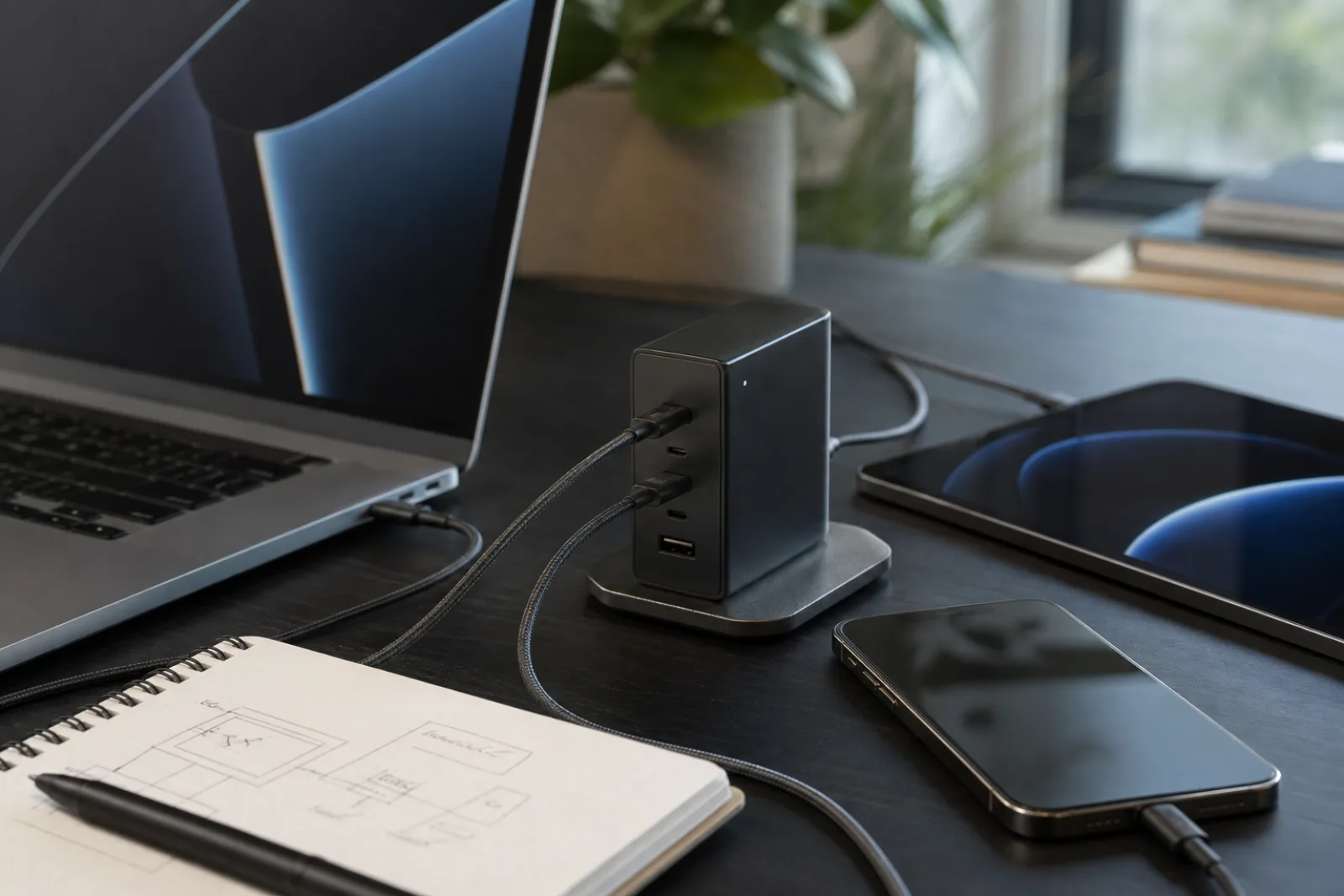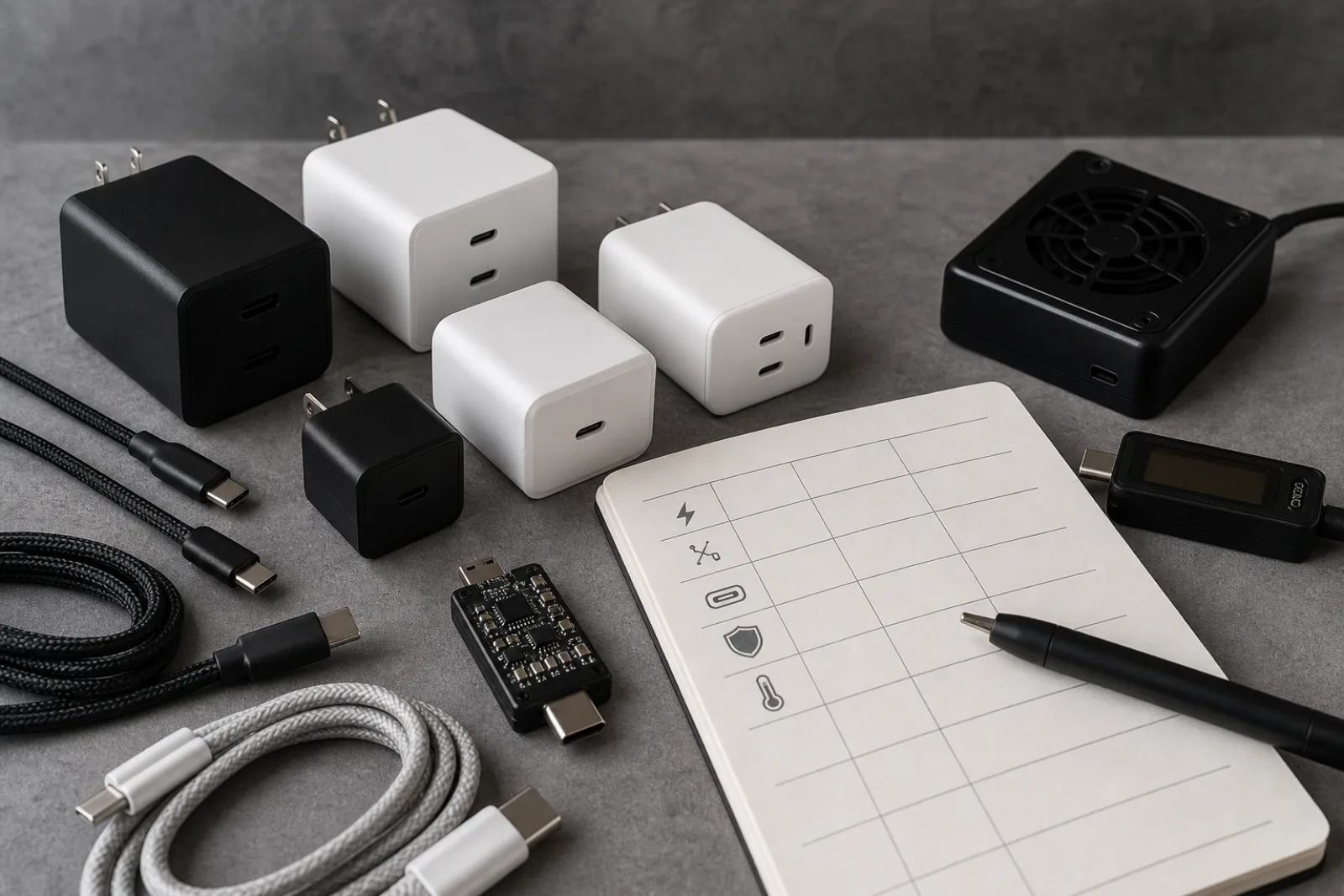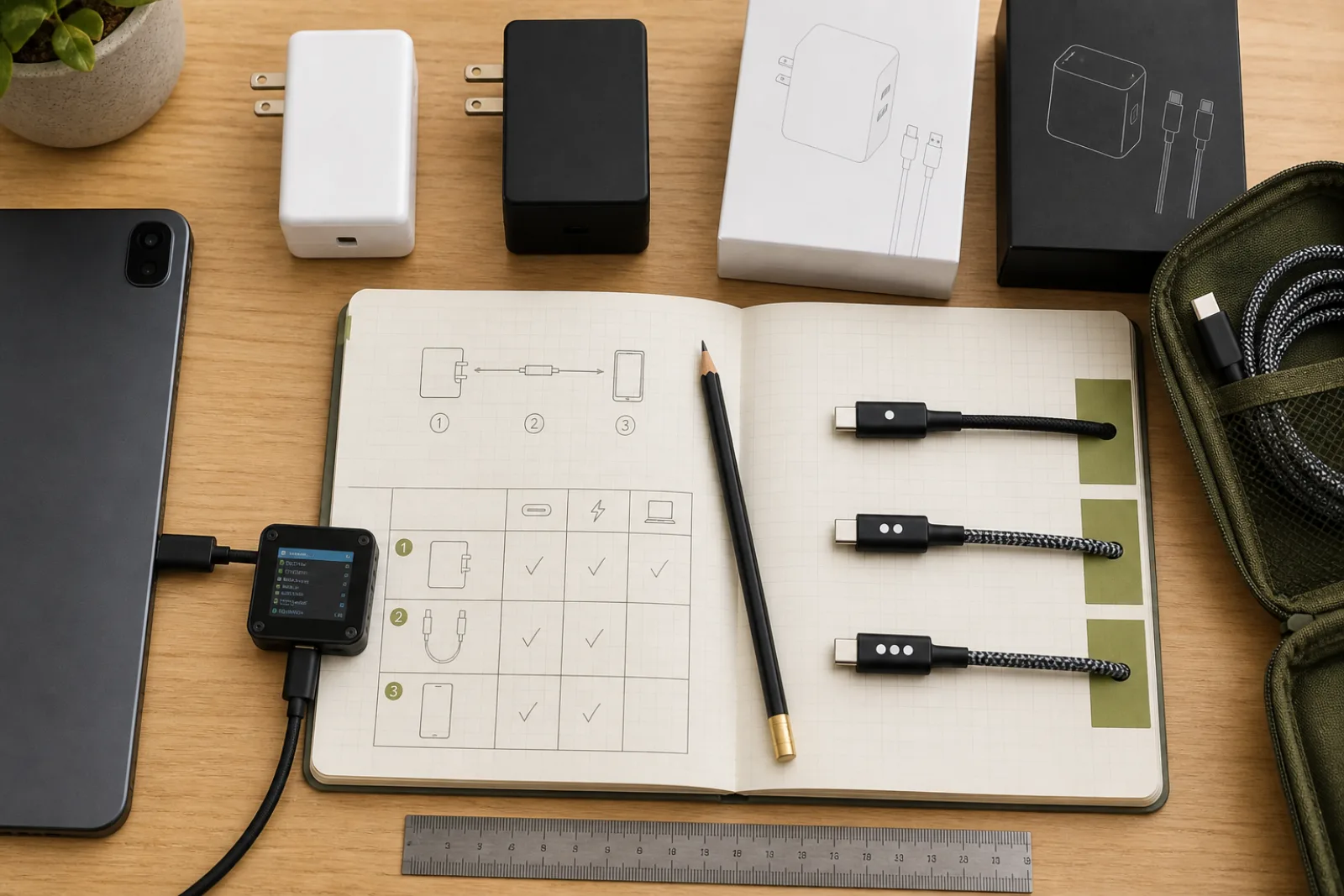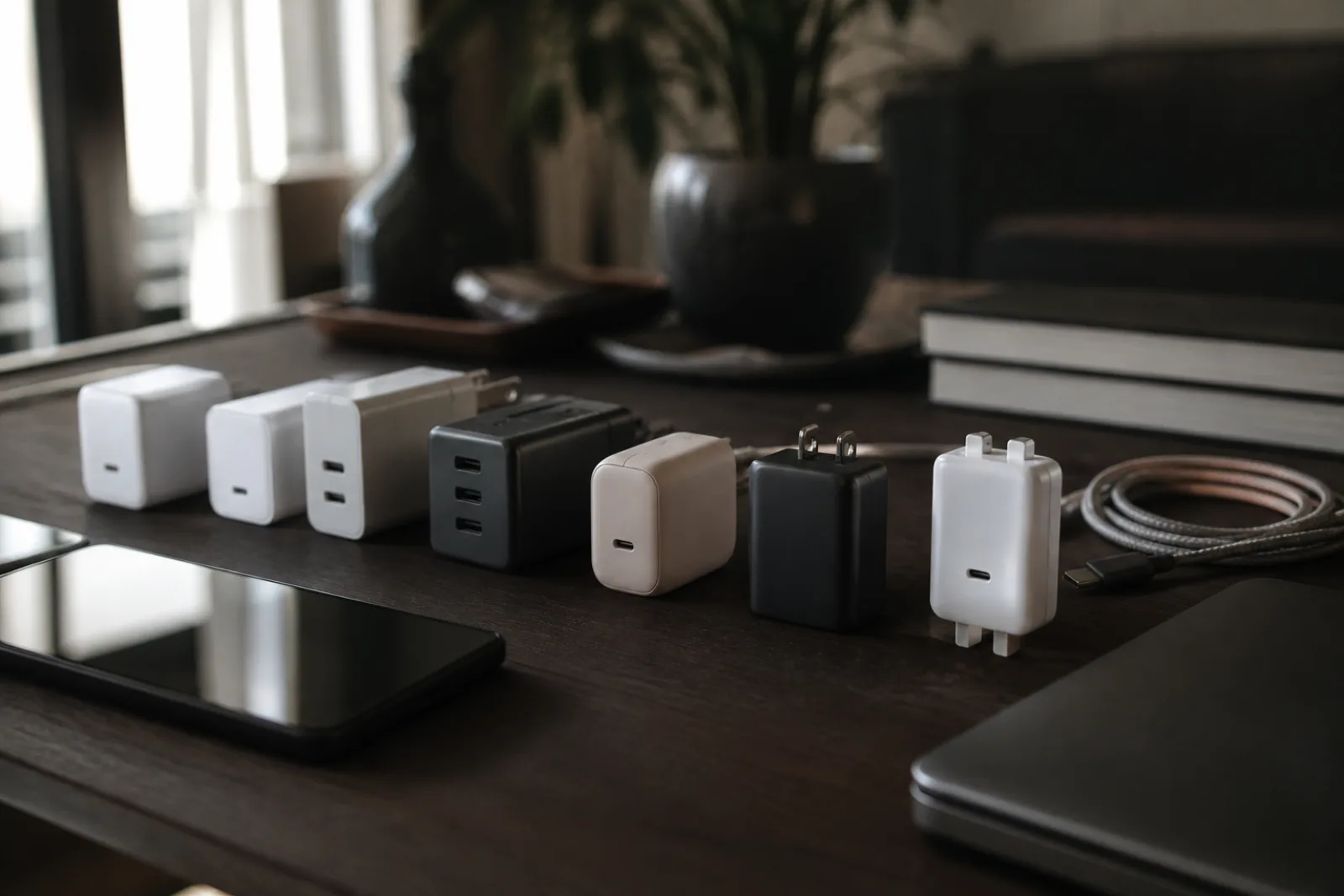
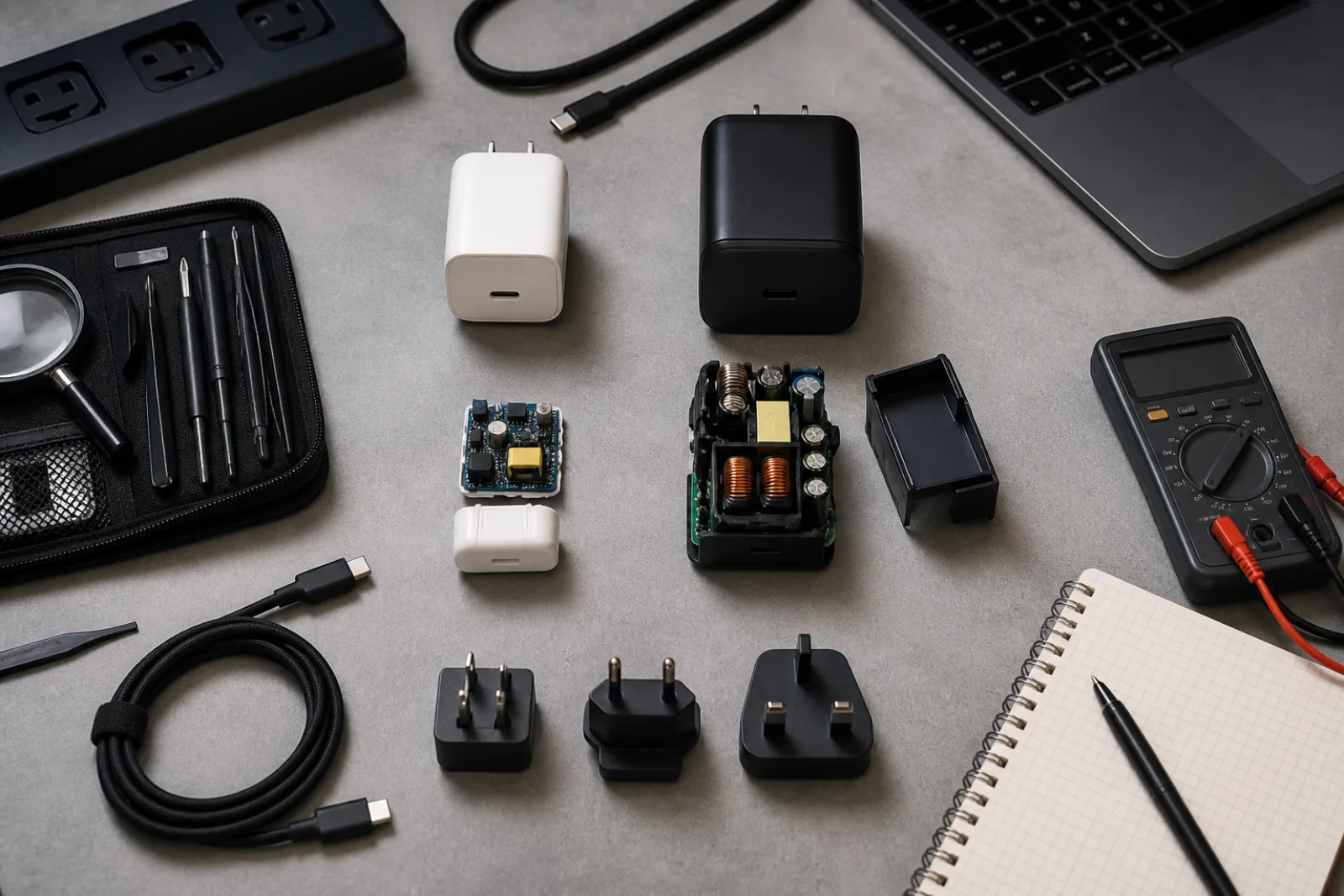
GaN showed up on charger boxes the way 'turbo' showed up on vacuum cleaners: as a word that sounds like speed. In the circuit, gallium nitride is the semiconductor in the high-voltage switch. Infineon's own USB-C adapter page is unusually plain about the benefit. Compared with silicon MOSFETs, GaN HEMTs take higher electric fields, present smaller capacitances, and switch fast enough that the transformer and capacitors can shrink. The brick gets smaller and runs cooler for the same wattage. The phone does not suddenly request a different USB PD contract.
If you already own a silicon 65 watt PD charger that feeds your laptop, GaN is a packing upgrade. If your laptop wants 100 watts and you bought a 30 watt GaN cube because it was cute, you bought the wrong ceiling in a nicer process technology.
| Question | What GaN changes | What still comes from somewhere else |
|---|---|---|
| Size and weight | Higher switching frequency, smaller magnetics, higher power density | Case design, number of ports, and whether the engineers actually used that headroom |
| Heat at a given wattage | Lower switching loss, reduced dead-time, Infineon: better thermals | Airflow, enclosure, and load. A tiny 100 W cube can still get hot. |
| Charging speed | Only if the design also implements a higher PD profile, or wastes less power as heat so it can sustain output | USB PD negotiation, PPS, the device's request, the cable |
| Safety and compatibility | Nothing automatic | IEC 62368-1 listing, USB-IF PD compliance, sane multi-port allocation firmware |
Silicon did not become illegal. Infineon still sells silicon superjunction MOSFETs into chargers that prioritize cost over cubic centimeters. Soft-switching topologies can make silicon efficient enough for a 65 watt adapter that you will not notice in a backpack. GaN's advantage shows up when marketing wants 65 or 100 watts in a volume that used to mean 30 watts, or when a 140 watt EPR adapter would be a brick of shame in silicon.
There is a second, quieter GaN claim: efficiency. Less energy dumped as heat is a real, small win for a travel charger on a hotel desk. It is not a climate identity. DoE and EU CoC efficiency rules already push both silicon and GaN designs toward high conversion efficiency. Treat '95 percent efficient' on a store page as a lab number at a sweet-spot load until you see a test report.
Counterfeit and unlisted GaN chargers exist because the word sells. The transistor does not make a thin plastic shell with no spacing a good idea. Look for a recognized safety mark and, if you care about PD behaving across brands, USB-IF certification. Then enjoy the fact that the honest 100 watt unit is no longer the size of a hotel soap dish's grandfather.
- You need the wattage anyway
- Match PD to the laptop first. GaN is how that wattage gets small, not how wattage appears.
- Volume in the bag matters
- Travel, two-port cubes, EPR adapters. This is Infineon's stated point of the technology in mobile adapters.
- You would not pay extra for size
- A competent silicon PD charger at the right wattage is still a correct charger.
Infineon USB-C chargers and adapters application page; USB-IF PD overview.
Process technology, not a standard
- 01
GaN: smaller, lighter, often cooler at the same PD wattage.
- 02
Speed still equals the PD contract plus the cable.
- 03
The word on the box is not a listing mark.
Questions
- 01Is GaN safer than silicon?
Not as a category. Safety is creepage, insulation, and listing. GaN's better thermals can help a design stay within temperature limits. A bad layout can still fail.
- 02Do I need GaN for USB PD 3.1 / 240 W?
You need EPR-capable PD controllers, a 5 A EPR cable, and a power stage that can deliver the watts. GaN is a common way to keep that stage small. It is not the definition of PD 3.1.
- 03Why is a tiny GaN charger sometimes more expensive?
The devices and the high-frequency magnetics cost more than a bulky silicon flyback. You are paying for density. That can be rational for travel and irrational for a nightstand.