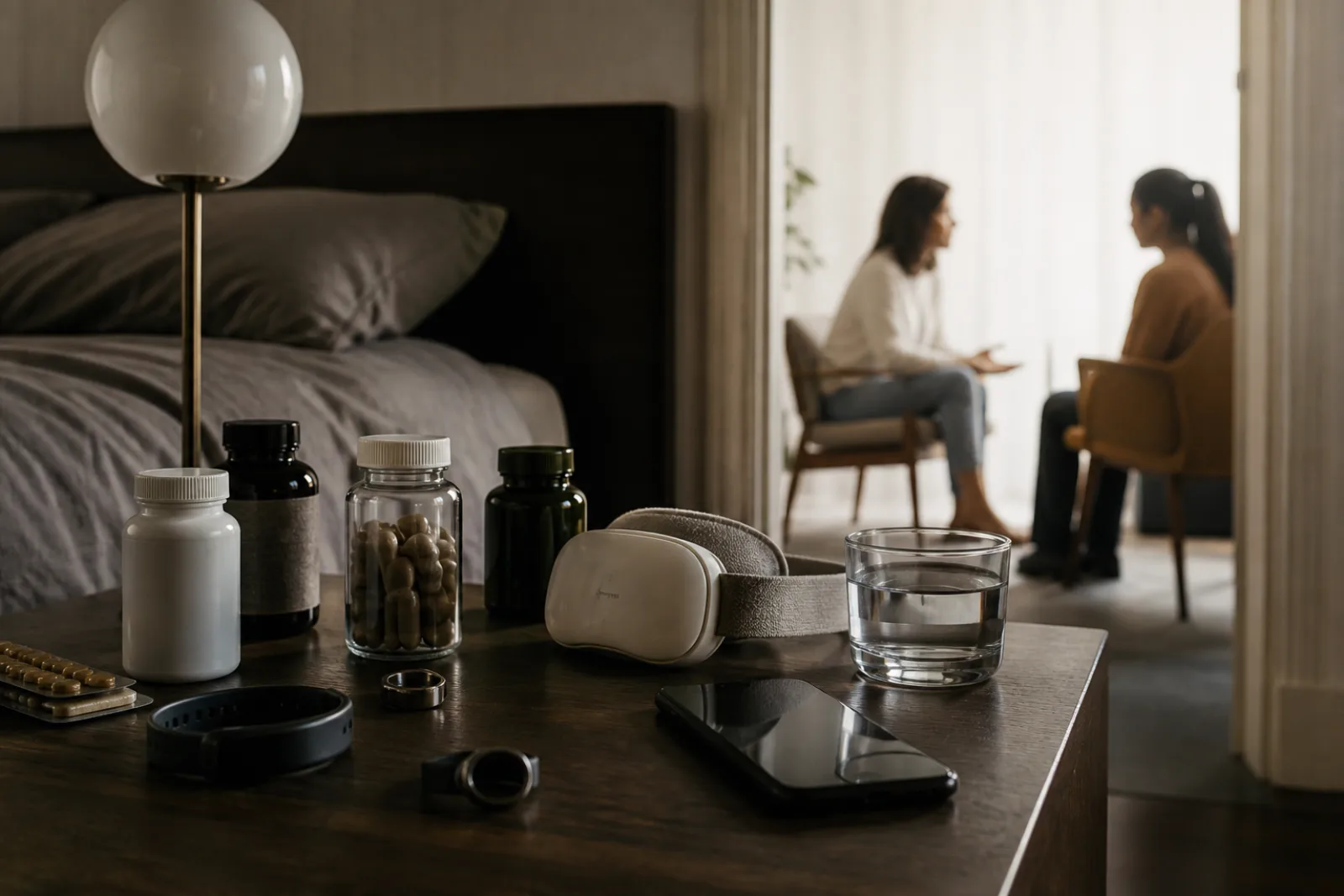
The modern bedroom has acquired a shelf's worth of purchased infrastructure: a ring or wristband that scores the previous night before the person wearing it is fully awake, a mattress that adjusts firmness and temperature through an app, a gummy or capsule taken nightly on the promise of restful sleep support, a white noise machine, blackout curtains, and a phone, technically banned from the room by every sleep guide that sells the rest of the equipment, still charging on the nightstand. Almost none of it is required to prove it works before it is sold.
Market-research estimates put the global sleep-tech device market at roughly $23 billion to $30 billion in 2025, depending on which firm's methodology is used, and the broader sleeping aids and supplement market near $92 billion the same year. Over that same decade of growth, the share of US adults getting too little sleep has not meaningfully moved; CDC survey data has put it between 30 and 35 percent for more than ten years running. The market got much bigger. The problem it claims to solve did not get smaller. The reason traces to two specific, named regulatory gaps, not to any particular product failing on its own terms.
What changed
The strongest recommendation is cognitive behavioral therapy for insomnia, which is not a mattress SKU.
Trackers, supplements, and smart beds grew into tens of billions. Adult short-sleep rates barely moved.
The market-sizing figures vary by firm because there is no single agreed definition of what counts as sleep tech. Straits Research puts the global sleep-tech market at $23.35 billion in 2025, growing to $65.69 billion by 2033. A separate estimate puts the broader sleep-tech devices category at $29.3 billion in 2025, projected to reach $134.7 billion by 2034. Polaris Market Research sizes the global sleeping aids and supplement market, which includes melatonin and other over-the-counter sleep products, at $92.39 billion in 2025. The mattress industry, a more mature and directly comparable category, was valued at roughly $47 billion to $49 billion globally in 2025, with the smart-mattress segment specifically, adjustable firmness, cooling, built-in tracking, estimated near $1.8 billion and growing faster than the category overall. These are industry estimates rather than audited figures, and should be read as directional, but the direction is consistent across every firm: expansion, year over year, across every product type sold as a sleep fix.
How the sleep-product shelf filled up while the underlying evidence moved differently
- 1994DSHEA passes
The Dietary Supplement Health and Education Act classifies melatonin and similar products as supplements, not drugs, meaning the FDA cannot require proof of effectiveness before they are sold.
- 2016 to 2020Melatonin sales roughly triple
US melatonin supplement sales grew from about $285 million to $821 million, per figures cited in CDC's later report on pediatric ingestions, well before any change in the underlying science of what melatonin does for adult sleep.
- 2017Orthosomnia is named
Rush University researcher Kelly Baron and colleagues publish the first clinical case series describing patients whose sleep-tracker data itself, not a diagnosed disorder, had become the source of sleep-disrupting anxiety.
- 2019FDA issues its general wellness guidance
The policy exempts low-risk products, explicitly including sleep trackers, from medical-device regulation, as long as they do not claim to diagnose a condition like sleep apnea.
- 2021AASM issues its insomnia treatment guideline
The American Academy of Sleep Medicine gives its strongest recommendation to cognitive behavioral therapy for insomnia and states sleep hygiene advice alone is not an effective stand-alone therapy.
- 2022CDC reports a 530 percent rise in pediatric melatonin ingestions
A CDC report covering 2012 to 2021 documents the poison-control and hospitalization toll of melatonin's much wider availability, including two deaths.
- 2023Lab testing finds inconsistent melatonin dosing
A JAMA research letter finds 22 of 25 melatonin gummy products tested contained doses that differed from their labels by more than 10 percent, some by over 300 percent.
AASM, CDC, NIH Office of Dietary Supplements, FDA, and Journal of Clinical Sleep Medicine, as cited in sources.
Those two regulatory facts are the actual mechanism connecting a growing market to a flat outcome. Under the 1994 Dietary Supplement Health and Education Act, a company selling a melatonin gummy can market it with structure-or-function language, such as supports restful sleep, without running a clinical trial, because the law does not authorize the FDA to demand proof of effectiveness before a supplement reaches shelves; the agency can only act after the fact, against products already found unsafe or mislabeled. Separately, the FDA's general wellness policy, most recently updated in January 2026, names sleep and activity trackers as low-risk products it does not intend to regulate as medical devices, on the condition that they do not claim to diagnose a condition such as sleep apnea. A ring reporting a nightly readiness score or a REM sleep breakdown operates inside that exemption; the moment a device claims to diagnose rather than track, it faces the far heavier evidentiary bar medical devices carry. Nearly every consumer sleep product on the market today stays on the light side of that line, the side that requires no independent proof the underlying metric is accurate.
All three trackers are reliable at the basic task of telling whether someone is asleep, but meaningfully less reliable at the stage-by-stage detail, REM, deep, and light sleep, that sleep-score and readiness features are actually built around and marketed on.
Accuracy of Three Commercial Wearable Devices for Sleep Tracking in Healthy Adults · accessed 2026-08-12 · 35 adults aged 20 to 50 without diagnosed sleep disorders wore an Oura Ring Gen3, Fitbit Sense 2, and Apple Watch Series 8 simultaneously for one inpatient night alongside polysomnography, the clinical gold standard; chart values are approximate midpoints of each device's reported per-stage sensitivity range.
Set against that is what sleep medicine's own clinical guideline actually recommends, and the contrast with what gets marketed is direct. The AASM's 2021 clinical practice guideline, built on a systematic review graded using the GRADE methodology, gives its strongest recommendation to cognitive behavioral therapy for insomnia, a structured behavioral treatment typically delivered across four to eight sessions that combines sleep education with specific techniques like stimulus control and sleep restriction. Between 50 and 75 percent of patients who complete it see clinically significant improvement, with benefits, including roughly a 30 percent increase in slow-wave sleep, holding up at six-month follow-up. None of that is a product in the conventional sense. It is a course of guided behavior change, harder to package, harder to ship, and dependent on access to a trained provider, which is exactly the kind of thing a retail or app-store business model struggles to sell at scale. The guideline goes further than simply omitting products from its top recommendation. It directly states that sleep hygiene education, tips about light, temperature, caffeine timing, and bedroom setup, the exact category most sleep-environment products implicitly sell, should not be used as a stand-alone therapy for chronic insomnia. The advice is not wrong. It is, according to the body that sets clinical guidelines, simply not enough by itself, which is a different claim than the one implied by a product marketed as a sleep fix.
| Marketed claim or implication | What the evidence actually shows |
|---|---|
| A tracking ring or watch reports precise REM, deep, and light sleep stages nightly | Peer-reviewed testing against polysomnography found 95-plus percent accuracy for simple sleep-versus-wake detection, but roughly 50 to 86 percent accuracy for specific sleep-stage classification, depending on device and stage |
| A melatonin gummy supports restful sleep, sold without a prescription | Melatonin is regulated as a supplement under a 1994 law that does not require pre-market proof of effectiveness; independent lab testing found 22 of 25 gummy products contained doses differing from their label by more than 10 percent, some by over 300 percent |
| A smart, app-connected, temperature-regulating mattress priced well above a standard mattress | A Consumer Reports survey of nearly 62,000 subscribers across 28 brands found meaningful but modest differences between brands; research consistently points to individual firmness fit and sleep position, not smart features specifically, as the stronger predictor of comfort and reported sleep quality |
| Sleep hygiene product bundles, white noise machines, blackout curtains, weighted blankets, marketed as fixes for poor sleep | The AASM's own clinical guideline states sleep hygiene changes are not an effective stand-alone therapy for chronic insomnia; its strongest-recommended treatment, cognitive behavioral therapy for insomnia, is a multi-session behavioral program, not a purchasable object |
Supplement makers benefit most directly from the regulatory structure: melatonin sales roughly tripled between 2016 and 2020 without any accompanying change in clinical evidence about what the hormone does for adult insomnia, and the law governing supplements means a company faces no obligation to prove a bottle works before selling it, only to avoid provable harm after the fact. Wearable makers benefit from a parallel gap: a device can imply clinical-grade insight, sleep-stage breakdowns, readiness scores, recovery metrics, while staying inside the FDA's low-risk general wellness exemption by avoiding any explicit diagnostic claim. Mattress companies benefit from a category where individual fit is genuinely hard for a shopper to evaluate without lying on the product for weeks, which makes premium smart features easy to sell as a proxy for a claim, better sleep, that is difficult for any individual buyer to disprove inside a return window.
The people worse off are concrete, not abstract. CDC's report on pediatric melatonin ingestions found a 530 percent increase in poison control calls between 2012 and 2021, rising from about 8,300 to more than 52,000 cases a year, with 4,097 hospitalizations, 287 intensive care admissions, and two deaths, both children under two, over that period; the report ties the rise directly to melatonin's much wider availability and to gummies specifically, which children can mistake for candy. Separately, Baron and colleagues' 2017 case series, which coined the term orthosomnia, describes a different kind of harm: patients who arrived at a sleep clinic not with a diagnosable disorder but with a fixation on their tracker's nightly score, whose pursuit of a better number had itself become a source of the sleep-disrupting anxiety they came in for. A device sold to fix sleep anxiety, in other words, produced a documented clinical case of causing it. Between those two groups sits a much larger, quieter one: people spending on trackers, mattresses, and supplements instead of pursuing cognitive behavioral therapy for insomnia, which carries the strongest evidence of anything discussed here but is also the hardest of all of it to find, since it depends on a trained provider rather than a checkout page.
What actually changed
- 01
The sleep-product market expanded into the tens of billions of dollars across trackers, supplements, and smart mattresses, while CDC data shows the share of US adults getting insufficient sleep has stayed in the same 30 to 35 percent range for over a decade.
- 02
Two specific, named regulatory carve-outs, the 1994 supplement law and the FDA's general wellness exemption for trackers, allow most of these products to market sleep-related claims without the kind of proof a medical treatment would require.
- 03
The treatment with the strongest clinical evidence, cognitive behavioral therapy for insomnia, is a multi-session behavioral program with no product attached, and the guideline recommending it explicitly says the category of advice most consumer products sell, sleep hygiene tips, is not sufficient on its own.
- 04
The harm is documented, not hypothetical: CDC recorded a 530 percent rise in pediatric melatonin poisoning cases over a decade, and researchers have clinically described trackers causing the sleep anxiety they were bought to fix.
Questions
- 01Are sleep trackers like Oura or Whoop worth trusting?
Peer-reviewed testing found them highly accurate, 95 percent or higher, at telling whether you are asleep or awake, but meaningfully less accurate, roughly 50 to 86 percent depending on the device and sleep stage, at the specific REM, deep, and light sleep detail their scores are built around. They can be a reasonable rough guide, but clinicians warn against treating the nightly score as precise or as a diagnosis.
- 02If sleep hygiene tips are not enough on their own, why do doctors still recommend things like a dark, cool room or a consistent bedtime?
Because they remain useful as part of a broader plan, just not sufficient by themselves for chronic insomnia. The AASM's guideline pairs its strong recommendation for cognitive behavioral therapy for insomnia, which includes stimulus control and sleep restriction techniques, with a specific note that sleep hygiene advice alone should not be used as a stand-alone treatment.