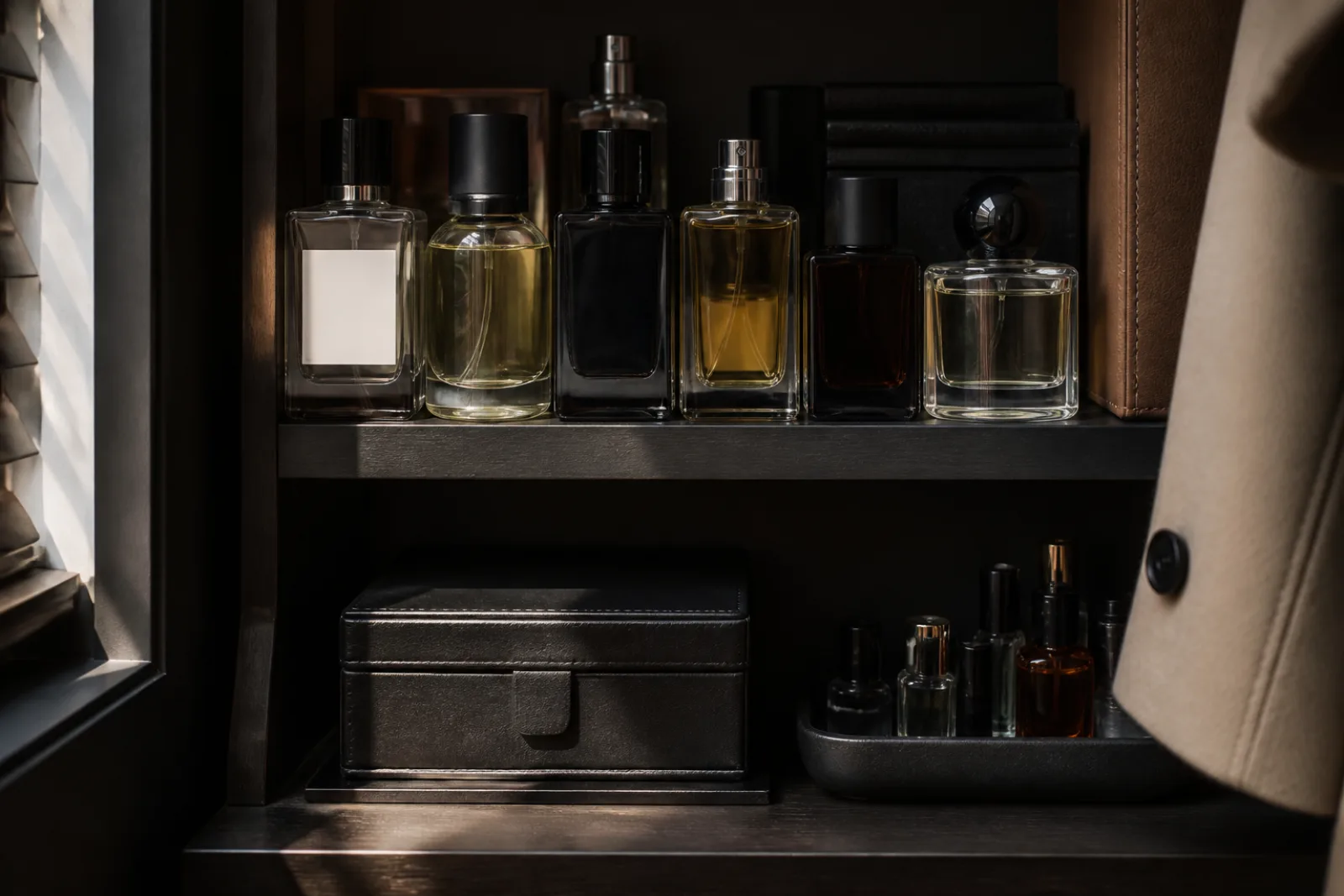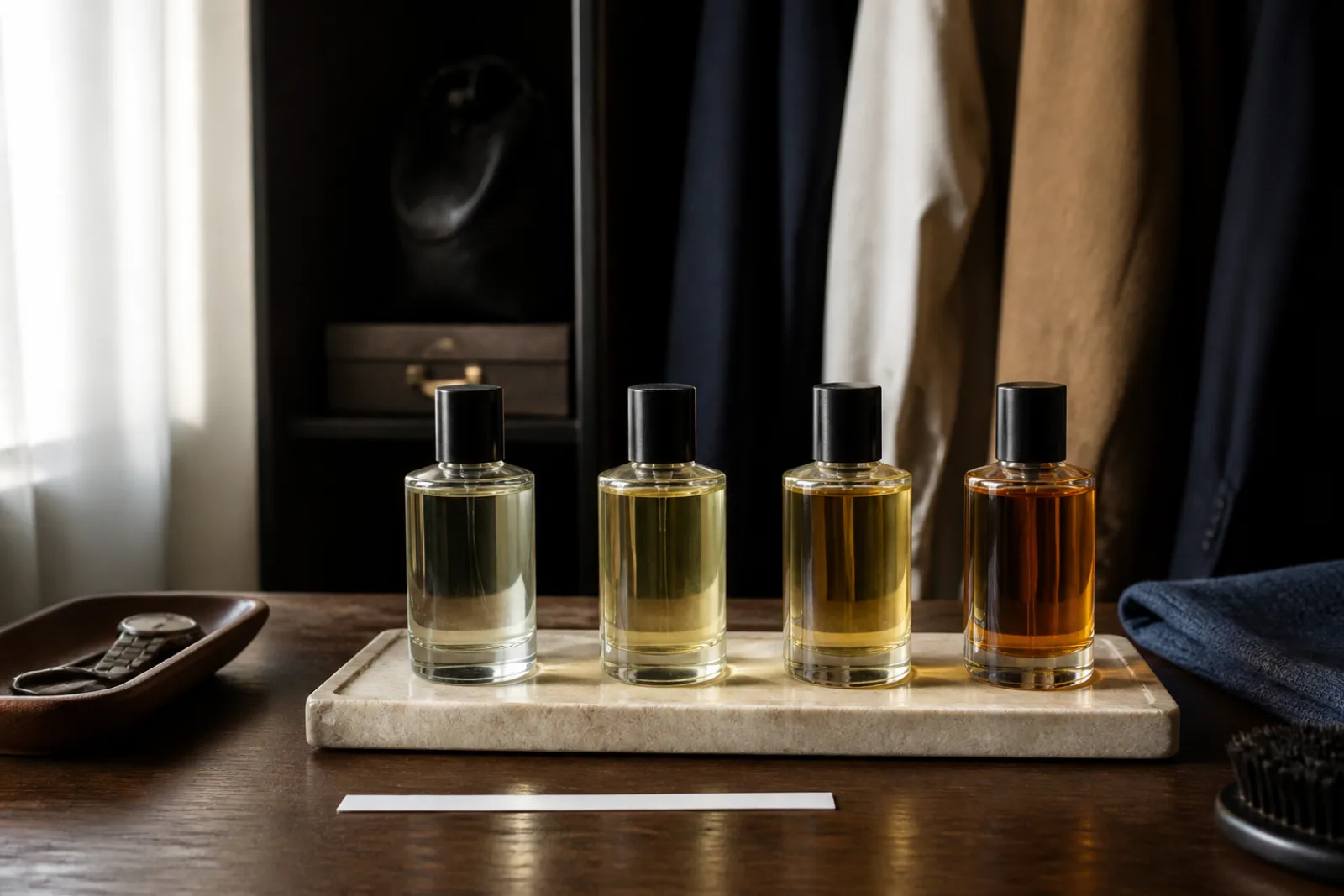
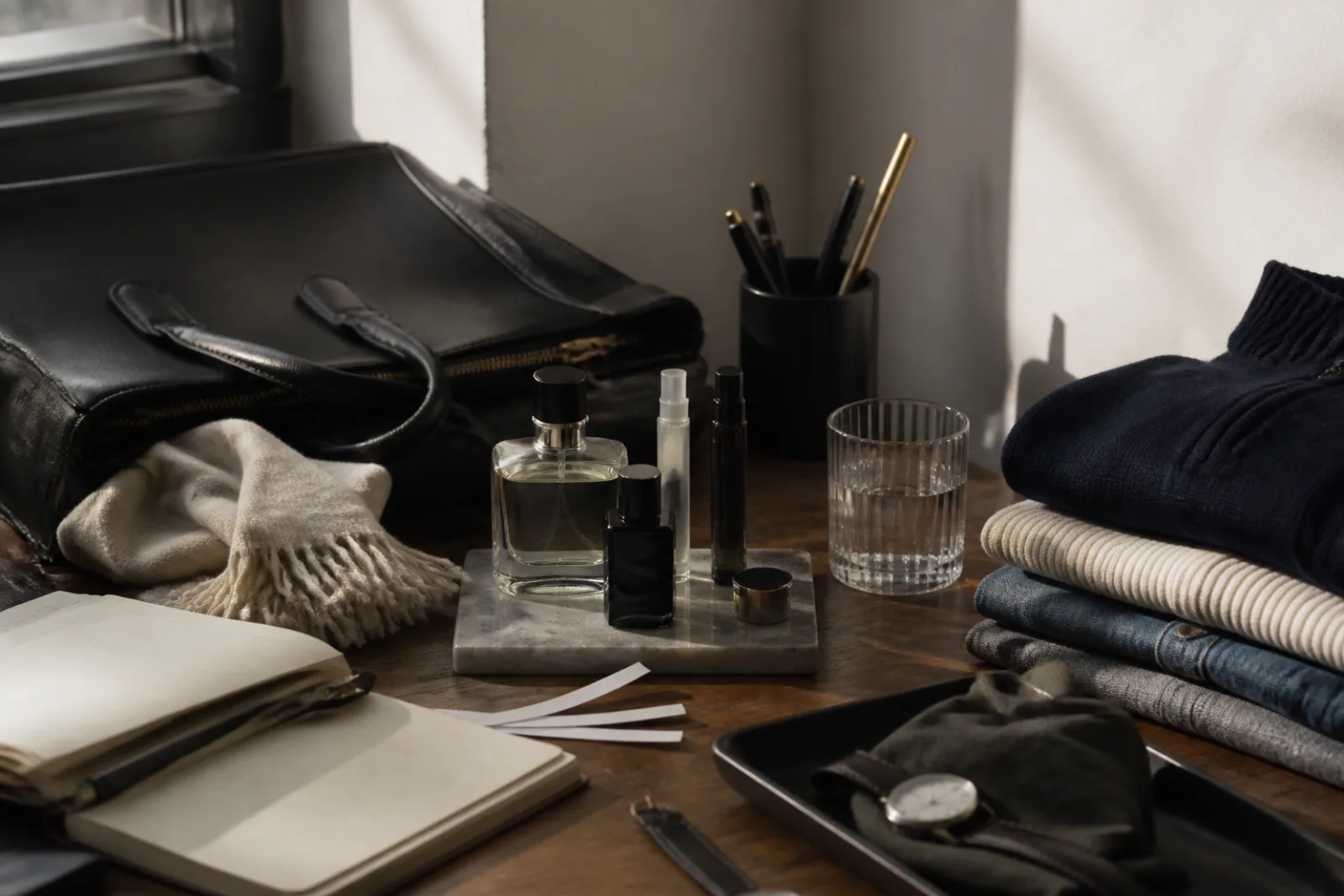
A fragrance counter is designed for the first ten seconds. Alcohol lifts a cloud, the strip smells like the idea of the bottle, and you are asked to choose before the thing you will actually live with has shown up. Daily wear is the opposite situation: a small amount, on skin, in a room with a closed door, three hours later. Those two tests disagree often enough that people own a 'signature' they only like in the store.
Concentration labels will not save you. Eau de parfum versus eau de toilette is a conventional range, not a legal strength, which is already covered in the companion piece on what those words mean. For a workday, you need a wearing protocol, not a better vocabulary for the cap.
A skin test that matches a workday
- 01Strip first, briefly
Use paper only to reject what you already know you hate. Do not buy from a strip.
- 02One spray on skin
Inner elbow or the side of the wrist you will not wash immediately. Not both arms with four different bottles. You will smell a chord, not a fragrance.
- 03Walk away for an hour
No coffee on that wrist, no rubbing. The opening notes are mostly solvent and the loudest materials. Daily wear is what remains.
- 04Smell it in a small room
Go home, or sit in a car. If it fills the space from one spray, it is an evening or outdoor scent at that dose, not an office scent.
- 05Check the next morning
If anything is left on a sweater or the wrist, that is the true daily ghost. Decide if you want to live in it.
Skin changes fragrance because it is warm, slightly oily, and not paper. A citrus that sings on a strip can be gone on you in twenty minutes. A musk that seemed quiet can be the only thing left at lunch. That is not a defect in you. It is why samples exist. A travel spray or a vial you can wear three days in a row is worth more than a full bottle bought in a mood.
Dose is the daily-wear skill. Fragrance is for you and for the air a few inches out. It is not a room diffuser. One spray on the chest under a shirt, or one on the back of the neck, is a reasonable office start. Wrists rub against desks and keyboards and will pump more scent into a meeting than you think. If you cannot smell it, wait; noses go numb to a smell they sit in. Asking a person you trust, later, is more accurate than chasing a cloud with a fifth spray.
| Context | What usually works | What usually does not |
|---|---|---|
| Open air, walking | Almost anything at a moderate dose; wind eats it | Using this as proof it is 'light enough' for a cubicle |
| Open-plan office or a small meeting room | One or two sprays of something that is already quiet at hour two | A beast-mode extraits, or reapplying at the desk |
| Transit, packed train | Even quieter, or none. You do not own that air. | A heavy sweet or a huge citrus opening in July |
| Evening, dinner, outdoors | The louder bottle, still not a fog machine | Treating 'daily' and 'night' as the same formula at the same dose |
Sensitivity is part of the brief. Fragrance is a common headache and asthma trigger for other people, and sometimes for you. A workplace that asks for unscented is not a fashion insult. If you get a tight chest or a headache from your own bottle, stop using it. If colleagues flinch, drop the dose or the bottle. There is no prize for being noticeable.
Season and fabric matter more than 'fresh for summer' copy. Heat amplifies projection. A wool coat will hold scent until Thursday. If you wear the same jacket every day, you are layering yesterday's fragrance under today's, which is how a 'light' daily scent becomes a cloud. Wash the points of contact. Do not spray the coat as a shortcut.
Time, skin, small rooms
- 01
Buy from a skin test that lasted into hour two, not from a strip at the counter.
- 02
Dose for the smallest indoor space on your day. You can add a spray. You cannot un-spray a meeting.
- 03
If it bothers you or other people, it is the wrong daily fragrance, however much you like the bottle.
Questions
- 01Should I pick a 'fresh' scent for daytime?
Fresh is a marketing mood. Some citruses vanish; some 'fresh' musks fill a room. Use the hour-two test. The word on the box is not a ventilation rating.
- 02Is it better to spray clothes than skin?
Clothes hold scent longer and you cannot wash a wool coat every night. Skin is a more honest daily test and a more polite office habit. If you spray fabric, do it rarely and lightly.
- 03How many daily fragrances do I need?
One that passed the workday test is enough. A second for evenings is optional. A shelf of untested full bottles is a collection, not a routine.