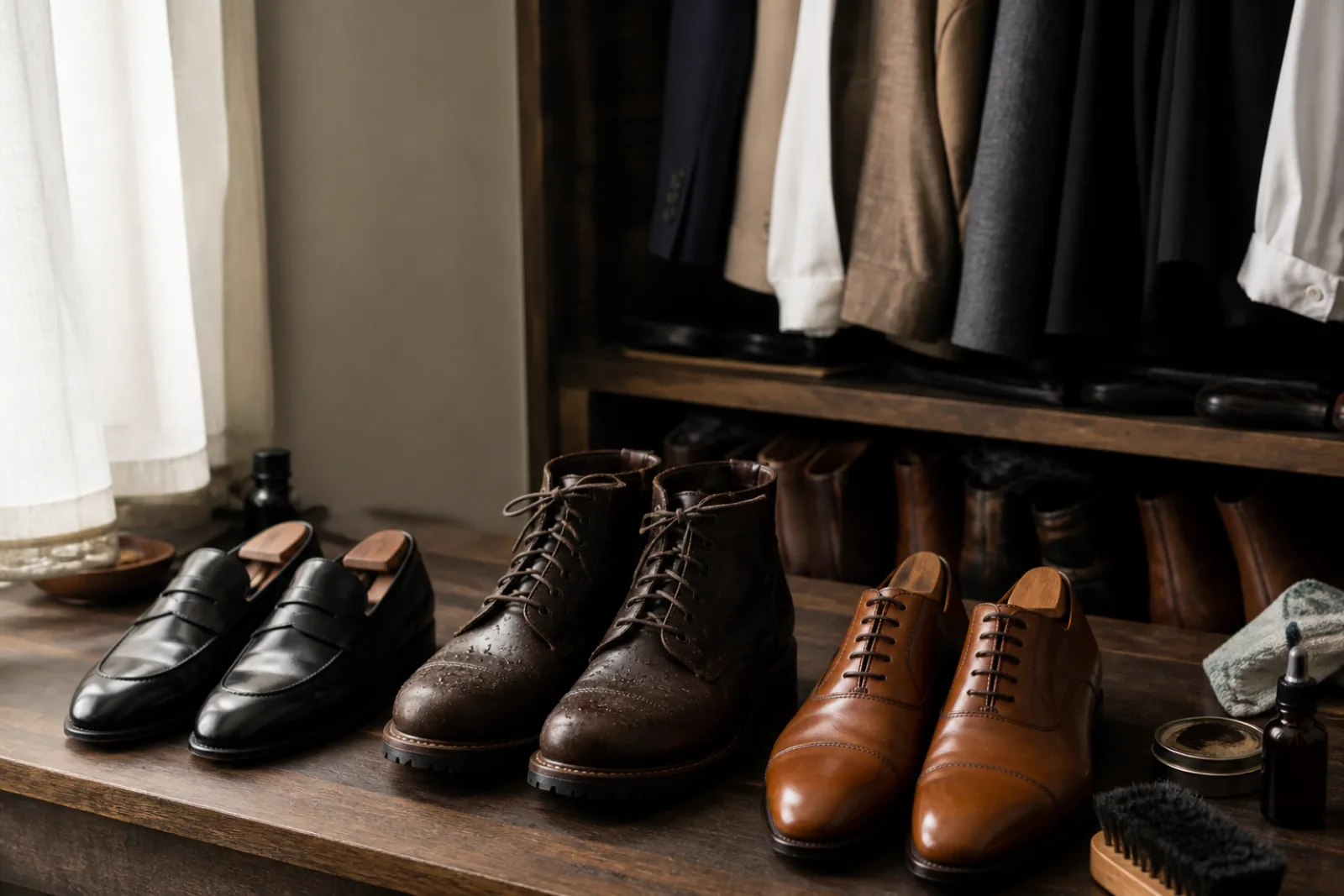
A closet full of shoes is not a rotation. A rotation is a small set in which each pair has a job the others cannot do, and in which leather is not asked to work two days in a row. The usual failure is the opposite: four pairs that all look like weekend sneakers, one pair of leather shoes worn Monday through Friday, and nothing you trust on a wet pavement. The leather dies from never drying. The sneakers duplicate each other. The wet day still ruins the only pair you walked in.
Count hours and weather before you count style. If you stand or walk more than an hour at a stretch most days, the walking pair is the rotation. Everything else is secondary. If your streets are wet or salted for months, traction and a sole that can take water are not optional extras. If you have a workplace or a life that still wants a leather shoe, that pair can be one pair, not five, as long as it is not also your rain shoe and your walking shoe.
| Slot | Job it has to do | What it is not |
|---|---|---|
| Walking / standing pair | Stay comfortable for the hours you are actually on your feet. Cushioning, last shape, and a sole you can walk a mile in. | A fashion sneaker that looks sporty and hot-spots at forty minutes. Looks are not mileage. |
| Weather pair | Traction on wet or slick ground, and an upper and sole that can take rain, slush, or salt. Rubber outsole, sealed or treated upper as your climate requires. | Your only leather oxford in a storm. Smooth leather soles on wet stone. A canvas sneaker in slush. |
| Dress pair | Meet the most formal setting you regularly enter, for the duration you are actually there. | An all-day walking shoe unless it has already passed an hour-plus comfort test in those clothes. |
| Rest / dry pair (same job, alternate day) | A second walking or dress leather pair so each can dry 24 hours. This is rest, not variety. | A different color of the same hurting last. Rest only works if the pair is actually wearable. |
The minimum is often three pairs, and sometimes two. If you live somewhere dry and your dress code is the same as your walking life (a comfortable leather sneaker, a broken-in boot), two pairs that you alternate may be the whole rotation, because the second pair's job is rest. If you live somewhere wet and you also have an office that wants a leather shoe, you need the weather pair as a true third: a rubber-soled boot or shoe you can walk in on a bad day without destroying the dress pair. Do not invent a fourth pair 'for travel' or 'for the gym' until those three jobs are covered. A gym shoe is a fourth job only if you actually go.
Hours on your feet are the test the shop cannot fake. Walk around the block, or stand in the shop longer than is polite. A pair that feels fine at minute five and burns at minute sixty is not your walking pair, no matter how many outfits it supposedly completes. Last shape (how the shoe is formed over the foot) and the insole stack matter more than a cushioning slogan. If you stand at a counter or a classroom all day, you may want a walking pair that looks plain enough to wear with your work clothes, and a dress pair that only comes out when the walking pair would look wrong. That split is the rotation working. Forcing one pair to be both is how people limp home in good-looking shoes.
Leather needs a day off because it is a skin, and it takes up water from your foot. A day in leather shoes leaves the lining and insole damp even when the outside looks fine. Worn again the next morning, that moisture stays in the leather, the stitching, and any cork or board in the footbed. The lining breaks down, the insole packs permanently, and the upper creases wet and then sets. This is cobbler common sense, not a luxury ritual. Two wearable leather pairs, alternated, last longer than one pair worn every day and then replaced. Unfinished cedar shoe trees help the drying and keep the forefoot from collapsing. They do not replace the day off. Mesh and synthetic sneakers dry faster and can often be worn more often, which is why they eat the walking slot for a lot of people. They still need a weather plan. A mesh runner in a cold rain is a wet sock with laces.
Traction is a sole question. Smooth leather dress soles are quiet and traditional and slick on wet stone, wet leaves, and office marble. A rubber top lift on the heel, or a full rubber sole, is the difference between a dress shoe you can walk to the office in and a dress shoe that belongs in a bag. If your city is wet, either the dress pair has rubber under it or the weather pair is what you commute in, with the dress pair waiting under the desk. Salt and slush want a boot you can wipe down, not a suede sneaker. In ice, nothing in a normal rotation replaces a dedicated winter sole. Do not pretend a fashion chunky sneaker is that sole because the outsole is thick.
A shoe worth rotating is a shoe a cobbler can keep on the road. Look at these before you buy the 'investment' pair.
- 01Heel lift (top piece)
The first thing to wear on a dress or boot heel. Cheap and quick to replace if the heel block is still intact. If you can see the nails or the wood, you waited too long.
- 02Outsole
Goodyear welt and similar welted constructions, and many Blake-stitched shoes, can be resoled by taking the sole off and putting a new one on. Cemented (glued) soles can sometimes be replaced once by a good cobbler. Injection-molded sneakers usually cannot.
- 03Welt or bond line
On a welted shoe, a stitch line runs around the edge where the sole meets the upper. That is the sign a resole is a normal job. A smooth glued edge with no stitch is cemented construction.
- 04Upper leather
The expensive part. If the upper is still sound, resoling is worth it. If the upper is cracked through, creased white, or the lining is shredded, stop putting money into the sole.
Repairability is how a rotation stays small instead of becoming a landfill schedule. A welted leather shoe (Goodyear welt is the name most shops use: a strip of leather stitched to the upper and insole, with the outsole stitched to that strip) can take new soles more than once. Blake stitch, a through-stitch that holds the sole to the insole, is also resolable, though fewer cobblers love it. Cemented shoes, which is most contemporary fashion footwear, can sometimes get a new sole glued on if there is a distinct sole to grind off. Many sneakers are a foam midsole molded or bonded in a way that leaves nothing to attach to. Those are walking pairs with a known lifespan. Buy them for the hours they give you, not as heirlooms. Putting a $200 'investment' label on a cemented fashion sneaker does not make it welted.
Heel lifts are the maintenance that actually happens. Dress heels wear at the back corner first. Replacing that small piece costs little and keeps you from walking on the heel block, which is a bigger repair. If you will not walk to a cobbler twice a year, do not build a rotation out of shoes that need one. A rubber-soled walking shoe you can wear down and replace may be more honest than a leather-soled oxford you will run into the ground. The rotation should match the maintenance you will do.
Build the rotation in this order. First, the walking pair that already passed an hour on your feet, in the clothes you actually wear to do that walking. Second, if your forecast includes months of wet or salt, a weather pair with a rubber sole you trust. If the walking pair is already that boot, you do not need a duplicate. Third, the dress pair for the settings the walking pair cannot enter, fitted and walked in long enough to know it will last the event. Fourth, only if the walking or dress pair is leather you wear often, a second pair in that same job so each can dry. That fourth pair can look almost the same. Sameness is the point. You are buying rest, not a new identity.
What you can skip: a third color of the same sneaker, a 'versatile' loafer that hurts, a white fashion shoe that cannot take rain and cannot take a cobbler, and any pair whose only job is completing a photograph. If a pair does not earn a slot in the table above, it is not in the rotation. It can still live in the closet for a specific event. It should not be what you reach for on a wet Tuesday when the walking pair is shot and the leather pair is still damp from Monday.
Do you need another pair?
What job is currently failing?
- 01What is actually going wrong?
Name the failure before you shop. A new pair that duplicates a working slot will not fix a missing slot.
- Feet hurt after an hour in the pair I wear mostYou need a walking pair that passes a real hour test, not another lookalike. Do not 'stretch' a painful last into an everyday shoe.
- Wet or slick days ruin my only wearable pairYou need a weather slot: rubber sole, an upper that can take water. This is not a dress-shoe problem.
- I have nothing that meets a dress codeOne dress pair, walked in at home first. Rubber on the sole if you commute in it.
- My leather shoes smell, pack down, or the lining is rottingYou need rest, not a new style: a second wearable pair in the same job, alternated, with trees if you have them.
- 02Is the pair you want to buy repairable?
If it is meant to be the dress or walking leather slot for years, look for a welt or a distinct sole a cobbler can replace. If it is a molded sneaker, treat it as a timed walking pair.
- Welted or clearly resolableFair as a long slot if it also passes comfort and weather-for-that-slot.
- Cemented or molded, cheap to replaceFair as a walking pair with a known end date. Do not call it an investment.
Questions
- 01Can one pair of leather sneakers be the whole rotation?
Only if they stay comfortable for your hours, handle your weather, meet your dress code, and you have a second pair or a fast-drying alternative so the leather can rest. That is four jobs. One pair rarely does all four.
- 02How long should leather rest?
Overnight is the minimum after a full day. A full day out of rotation is better. If the lining still feels cool and damp in the morning, they are not ready.
- 03Are expensive sneakers worth resoling?
Ask a cobbler while the midsole is still intact. Some cup soles can be replaced. Many foam midsoles cannot. Price paid does not equal resolability.