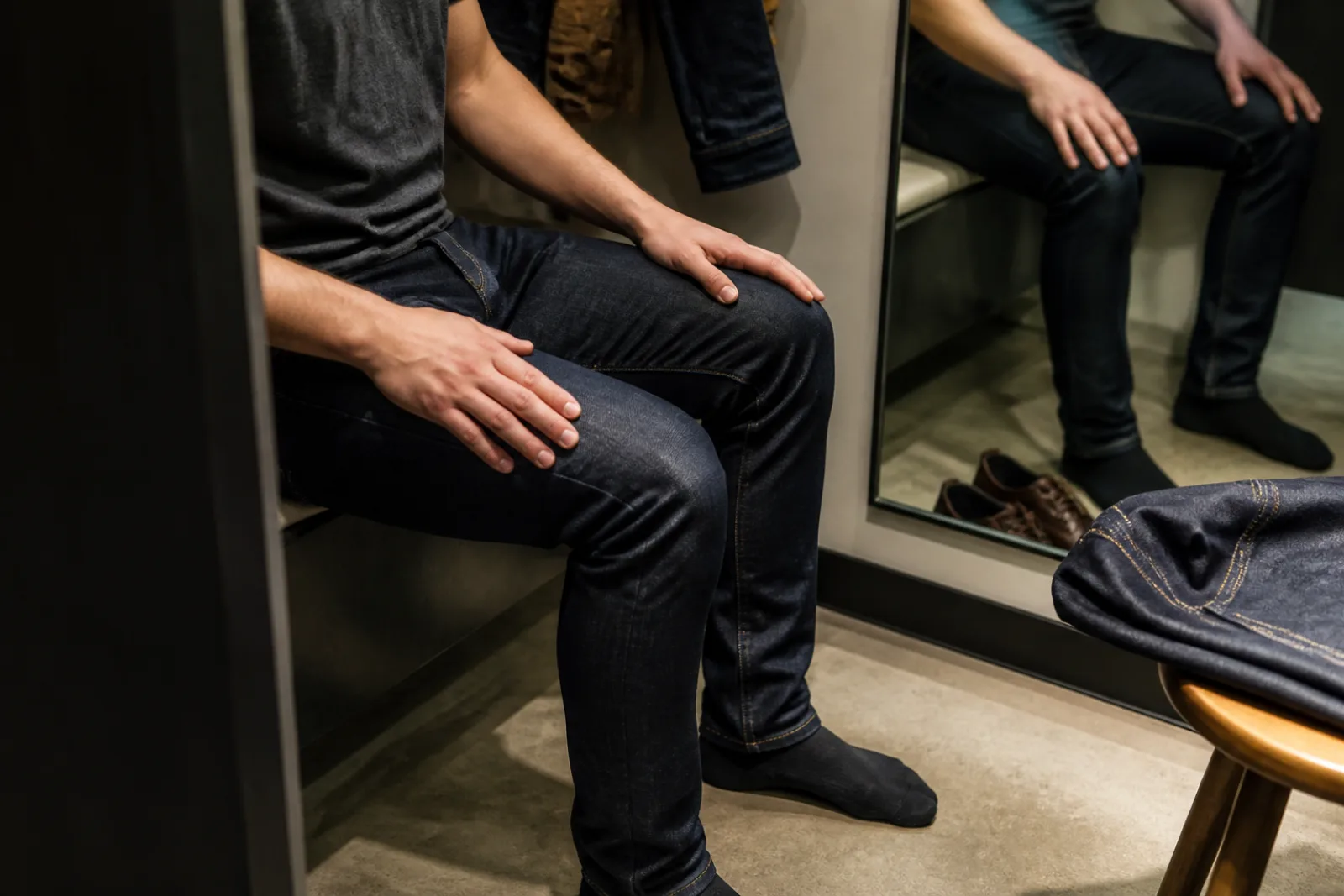
The fitting-room mirror is a standing portrait. Jeans are a sitting, walking, stair-climbing garment. If you only look, you will buy a waistband that looks centered on your hips and then slides under your belly the first time you take a chair, or a thigh that looks clean until you lift a knee and the fabric does not come back. Do the movement first. Look second.
Start with the waistband, not the wash or the brand's name for the cut. Fasten them on the hole you will actually use. Stand. Notice whether the band sits on your waist, on the high hip, or down on the hip bones. Then sit, all the way back in the chair. The band should stay roughly where you put it. If it dives, the jeans are either too big in the waist, too low in the rise for how you sit, or both. Breaking them in will not levitate a waistband. Fabric eases. Geometry does not.
Fitting-room sequence for jeans
- 01Measure the waistband, then put them on
Lay the jeans flat, measure the waistband from edge to edge, and double it. Compare that to your body where you want the band to sit. Then fasten on the hole you will use, not a hopeful inner hole.
- 02Stand and place the waistband
See whether the band sits on the waist, high hip, or hip bones, and whether it is level. A band that is already fighting to stay up while you stand will not improve.
- 03Sit all the way down
The back should still cover you. The crotch should not pull into a tight wedge or leave a bag of empty fabric. The waistband should not slide under the belly or gape in a hole at the small of the back.
- 04Walk, climb, and bend
Take a lap, pick up a knee as if for a stair, and bend to tie a shoe. Watch the knee and seat: the fabric should move with you and return. Check that front pockets are usable and that the thigh does not lock.
- 05Check inseam against the shoe you will wear
Note the break (how the hem hits the shoe). A pair fitted to sneakers will puddle on a dress shoe, and a pair fitted to a heel will look cropped in a trainer. Decide the shoe first.
- 06Read elastane percent and do a pinch-back at the knee
Pinch a fold at the knee, hold, release. Rigid cotton creases and slowly eases. Stretch should snap. If a stretch pair stays tented, it will bag in wear.
Rise is the measurement people treat as a trend and then blame on their body. A low rise sits below the navel, often on the hip bones. When you sit, your torso folds above that band. If there is not enough fabric between crotch and band, the back drops and you get the gap, or the band digs in at the front and the crotch seams pull. A mid rise sits nearer the navel and usually stays put for people who sit a lot, which is most people with jobs. A high rise comes up over the lower belly and covers more of the back in a chair. That is not automatically 'mom jeans.' It is a longer distance from crotch to band, which is what a longer torso or a belly that sits above the hip often needs. You cannot fix a short rise with a belt. A belt cinches a waistband that is already in the wrong place.
The crotch is the other half of rise. Standing, you want enough room to cup without an empty sack of fabric, and without the seam pulling up into a tight triangle. Sitting, you want the same seam to still exist. If it vanishes into your body, the rise is short or the thigh is too tight. If you could store a sandwich in it, the rise is long for you or the seat is too big. Walking a few steps tells you whether the thigh is going to lock. Jeans that look slim in a photo and will not let you take a stair are not a slim fit. They are a display fit.
Your knees and seat ask a lot of denim. Textile papers on stretch jeans cite movement figures on the order of about 25 to 30 percent extension at the seat and 35 to 45 percent at the knee when you flex, which is why a little elastane feels like relief and why those same spots bag when the yarn does not recover. Bagging is not a moral failing of the wearer. It is fabric growth: the knit or the stretch yarn takes a set after repeated or prolonged stress and does not come all the way back. Rigid 100 percent cotton does this too, but it does it as easing and creasing (whiskers, honeycombs) rather than as a shiny, collapsed knee. Stretch denim can look still 'new' in the wash and already slumped at the knee by evening if recovery is poor.
Read the fiber line. 100 percent cotton is rigid, or close to it. It will usually gain a bit in the waist over the first days of wear, often on the order of half an inch to an inch depending on the weave and your body, and then tighten again in the wash. Buy the waist that fastens without a fight and without a gap, knowing the afternoon will be easier than the first morning. One to two percent elastane is comfort stretch: you can sit and climb, and a decent pair should still look like the morning pair at dinner. Three percent and up is a different garment, closer to a jegging in behavior even when it still looks like denim. More stretch is not more quality. It is more give, and more need for recovery. Some stretch jeans use a dual-core yarn (elastane plus a second filament, often a polyester bicomponent) specifically because plain elastane core yarns are known to grow. You will not always see that on a hangtag. You will see it in the pinch-back test at the knee.
| Fabric | In the fitting room | After weeks of wear |
|---|---|---|
| 100% cotton (rigid) | Feels stiff. Waist should fasten firmly. Thigh and knee have little give, so you must be able to sit and climb without locking. | Waist eases. Creases form at hip and knee. Shape is yours. Knees bag less in a sloppy way, more as a break-in pattern. Wash tightens them back some. |
| Cotton with about 1-2% elastane | Sits and climbs more easily. Pinch at the knee should snap back. Waist can be closer to 'comfortable on the first wear.' | Holds a cleaner line if recovery is good. If recovery is poor, knees and seat slump while the wash still looks dark. |
| Higher elastane (about 3% and up) | Very easy movement, sometimes a shiny or spongy hand. Easy to size too small because they feel fine until they are on for an hour. | Highest bagging risk at knee and seat. Heat in the dryer can further dull the elastane. Follow the care line. |
Inseam is a shoe decision pretending to be a length. The hem either clears the shoe, kisses it (no break), puts a single fold on the vamp (a slight break), or stacks. Full break and stacking are what you get when the inseam is long for the shoe you are wearing. That can be the look you want. It is also how hems fray and how fabric pools over a trainer. Fit the jeans with the shoe height you will actually wear, or buy them long and hem to that shoe. A pair hemmed for a 25 mm heel will look cropped in a flat sneaker. A pair bought to puddle on a sneaker will swallow a dress shoe. If the shop will hem, stand in the shoes, let the extra fabric fall, and mark where you want the front of the hem to hit. Do not guess from the number printed on the ticket. Inseam 32 on one brand is not inseam 32 on another, and your shoes are not the mannequin's shoes.
Vanity sizing is not a conspiracy you need a paper to believe. It is the reason a labeled 32 can measure 34 or 36 inches around the waistband. Brands cut to their own last and then print a number people will buy. Measure. Waistband flat, doubled, compared to your body at the height you want the jeans to sit, which is not always the height you measure for trousers. If you wear a low rise, your 'waist' for jeans is a hip measurement. If you wear a high rise, it is closer to a true waist. Trying two sizes of the same cut is normal. Trying three brands in 'your size' without measuring is how you go home with a pair that only fit the label.
After the movement tests, look at these four places before you decide.
- 01Waistband
Level, still in the same place after sitting. No dive, no hard fold into the belly, no belt-only rescue.
- 02Back rise
Still covers the lower back in a chair. A hole of skin or underwear at the small of the back is a rise or seat problem, not a shirt-tuck problem.
- 03Knee
After a bend, the fabric should return. A remaining tent is a recovery problem, worse in higher-elastane pairs.
- 04Hem versus shoe
Front of the hem hits where you chose: above the shoe, at the top, or with a planned fold. Unplanned stacking is extra inseam, not extra style.
Pockets are part of fit. Put your phone or your hand in the front pocket and sit. If the pocket bag pulls the hip out of shape or the opening gapes, the cut is not made for that load. Back pockets that sit on the fullest part of the seat will look different from pockets placed high on the hip. That is pattern, not flattery. You can ignore it. You should not ignore a back waistband that gapes enough to show skin when you sit, because no pocket placement fixes that.
If you are between a rigid pair that fits your waist and fights your thigh, and a stretch pair that feels easy and already looks soft at the knee in the shop, take the rigid pair if you sit less and wash more, and the stretch pair if you sit all day and will air-dry them. Heat is hard on elastane. A stretch jean that can only be kept alive by a cold wash and a line-dry is still a legitimate pair. It is not the same care object as rigid denim you can throw in a hot dryer (which, for indigo, you may not want to do for other reasons). Fit first, then care, then the wash recipe you will actually follow.
Questions
- 01Should jeans be tight in the store because they will stretch?
Rigid cotton: they should fasten firmly, not painfully, and you must still be able to sit and climb. They will ease some in the waist. Stretch denim: they should already be wearable. If they only work because the elastane is maxed out while you stand, they will bag and they may never recover.
- 02Is a gap at the back waistband fixable with a tailor?
Sometimes, if there is enough seam allowance and the gap is a waist-to-hip mismatch, not a rise that is simply too short. A short rise that exposes your back when you sit is a different pattern. Taking in the waist will not add fabric to the back rise.
- 03Do I need a different inseam for sneakers and for leather shoes?
If the heel height differs by more than a small amount, yes, or you pick one shoe and hem to it. One inseam rarely serves both a thick-soled trainer and a dress shoe without looking wrong on one of them.