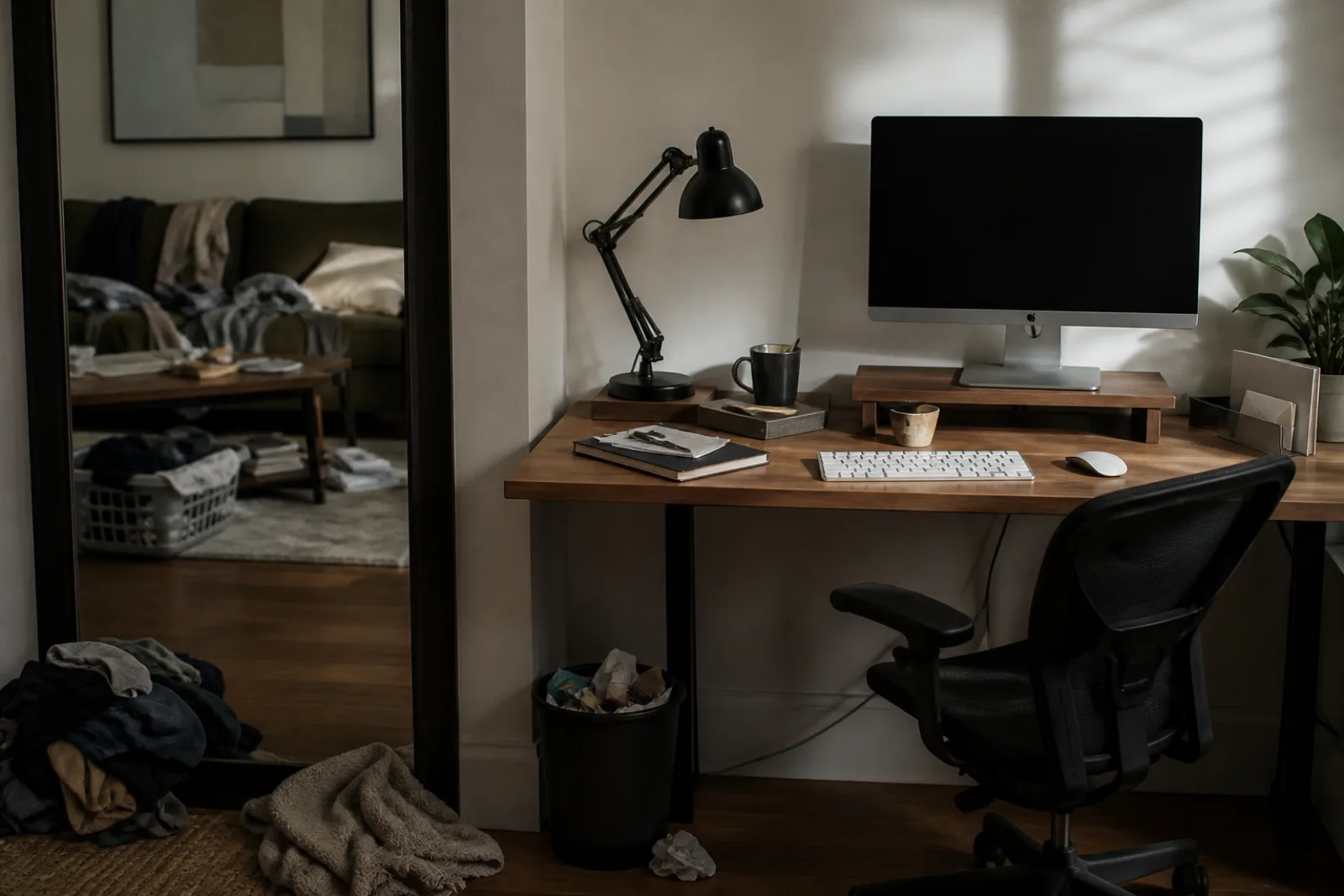
A desk used to be furniture you sat at. It is now, for a slice of the workforce, a picture you publish. The camera is usually a phone held above a mechanical keyboard, a monitor with a bias light, a plant that never drops leaves, and a floor that has been cleared of the walking pad's charging brick. The caption says setup, tour, or battlestation. The argument, rarely stated, is that this is how a serious person works.
That argument got a room to live in. The Bureau of Labor Statistics, using Current Population Survey questions added in October 2022, counted 35.5 million people who teleworked or worked at home for pay in the first quarter of 2024, 22.9 percent of those at work, up from 19.6 percent a year earlier. This is not a how-to for placing a monitor. Separate Culture Column guides cover OSHA's actual measurements. This is about what happened when the workstation became a public surface: tools turned into character, labor went off camera, and a photogenic desk started being treated as proof of comfort it was never designed to provide.
What changed
OSHA's setup guidance and sit-stand evidence care about posture, not marble and cable management.
Telework made the desk visible. Desk-tour videos turned tools into a public story about output.
The portrait is not evenly distributed. BLS found that 37.9 percent of people in management, professional, and related occupations teleworked in that first quarter, against 3.2 percent in production, transportation, and material moving, and 3.2 percent in natural resources, construction, and maintenance. Workers with a bachelor's degree or higher teleworked at 40.4 percent; those with less than a high school diploma at 3.5 percent. Desk-tour culture is a culture of the jobs that can be done on a laptop, which is why the objects in the frame skew toward monitors, keyboards, and plants rather than toward the tools of a job site. Pulsar, a social-listening firm, described the pattern in 2022: as work-from-home matured, personalizing a desk became less tied to simple utility and more to streaming culture, fandom, and what it called a productivity aesthetic. TikTok, in that analysis, helped send standing desks and under-desk bikes up bestseller charts. That is a claim about conversation and commerce, not about spines.
The filmed desk is a genre of the occupations that can leave the office. It is not a picture of American work. Most jobs still cannot be done from a marble slab with a plant.
Telework trends, Beyond the Numbers · accessed 2026-08-12 · U.S. Bureau of Labor Statistics, Current Population Survey, first quarter 2024. Telework rate is people who teleworked or worked at home for pay as a percentage of people employed and at work during the survey reference week. Not seasonally adjusted.
What the picture displays is a set of props with assigned meanings. A mechanical keyboard says craft and noise you have chosen. A second monitor says volume of work. A plant says you are not a machine. A walking pad under a standing desk says you have solved the body. Cable management, the tray, the sleeve, the hole drilled in the oak, says you have solved mess. None of those meanings are crazy. They are just not measurements. The same desk can wreck a wrist if the keyboard sits too high, which is a fact you cannot see in a top-down photograph that crops the chair.
Standing-desk marketing filled the gap where evidence is thin. Cochrane's systematic review of workplace interventions for reducing sitting at work found that sit-stand desks reduced sitting by about 84 to 116 minutes per workday at short-term follow-up, on low-quality evidence, and by about 57 minutes at medium-term follow-up in a smaller set of studies. Cochrane's own summary is blunt: although the desks are popular, their potential health benefits are very uncertain. A related Cochrane review of standing and walking interventions for musculoskeletal symptoms did not find conclusive reductions in pain. OSHA, which does not have a specific computer-workstation standard, still publishes an eTool that treats standing as one of four reference postures, alongside upright sitting, declined sitting, and reclined sitting. The agency's first instruction is not to buy a motorized desk. It is to keep joints in a neutral position and to change that position. 'Regardless of how good your working posture is, working in the same posture or sitting still for prolonged periods is not healthy.' A walking pad in a YouTube tour is a product. OSHA's sentence is a constraint. They have been allowed to look like the same advice.
| Question | Desk-tour image | OSHA Computer Workstations eTool |
|---|---|---|
| What is the desk for? | A public narrative: taste, output, control, sometimes fandom. | A surface arranged so joints stay roughly neutral while you type and look. |
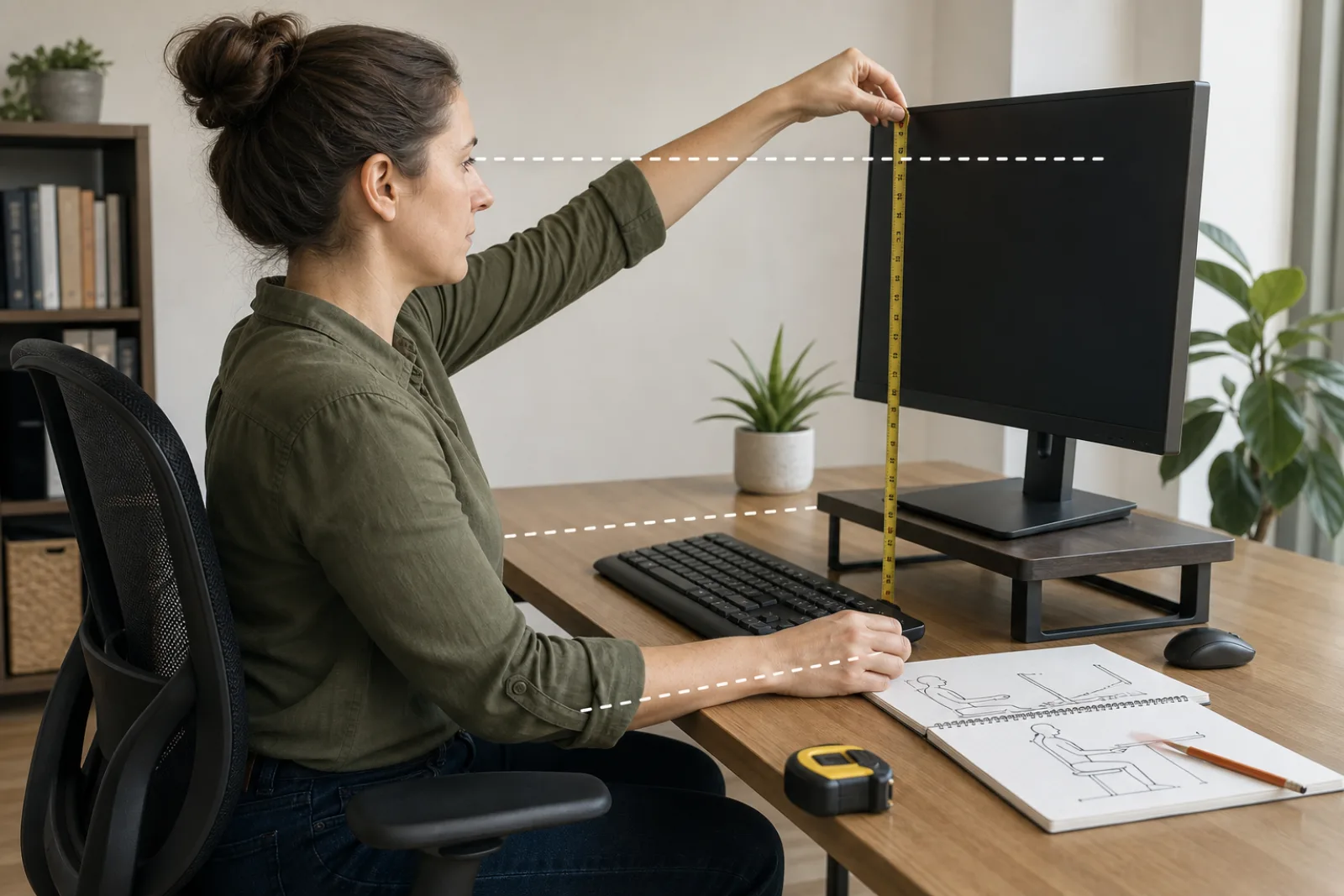
| Monitor | Big, centered, often with a light behind it. Size reads as seriousness. | Top of the screen at or below eye level, far enough that you are not craning, generally in front of you so you do not twist. |
| Keyboard and pointing device | Object of desire: layout, switches, wrist rest as accessory. | Close together, at a height that keeps wrists straight and elbows near the body, bent about 90 to 120 degrees. |
| Chair | Often cropped out, or shown as a design object. | Lumbar support, feet on the floor or a rest, thighs roughly parallel to the floor. Adjustability matters more than brand. |
| Standing | A lifestyle upgrade, frequently paired with a walking pad. | One of several postures. Prolonged standing is not the goal. Change position. |
| What is missing | Cables, paper, the other laptop, the body at 4 p.m., the person who tidied. | Nothing romantic. The eTool is a checklist, not a mood. |
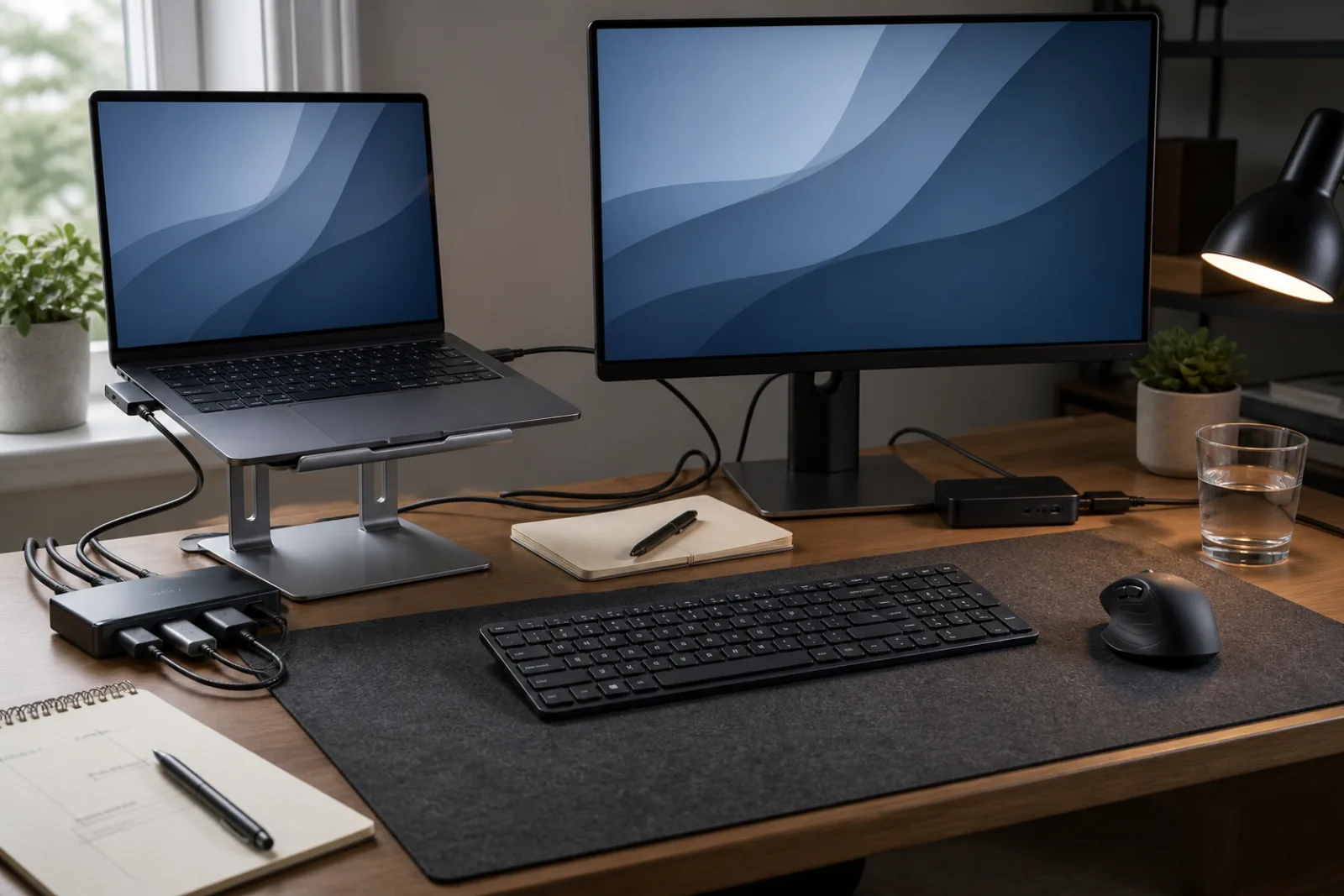
The typical top-down desk photograph is a composition. Each object is doing social work. OSHA's questions sit in different places, often outside the frame.
- 01Monitor light and centered screen
Narrative: cinema, focus, a person who works after dark. OSHA: is the top of the screen above your horizontal line of sight? Are you looking straight ahead or tilting?
- 02Mechanical keyboard, empty surface
Narrative: craft, discipline, nothing out of place. OSHA: are wrists straight, elbows close, forearms roughly parallel to the floor, or is this a hard slab at the wrong height?
- 03Plant, speaker, figurine
Narrative: you have a self. These are the easiest objects to stage and the least related to musculoskeletal load.
- 04Cable tray, grommet, hidden power strip
Narrative: mess has been solved. Labor: someone routed every cord. The photograph is the receipt for that unpaid or unshown work.
- 05Walking pad under a standing desk
Narrative: wellness without leaving the job. Cochrane: sitting time may fall; health effects of the furniture remain unproven. OSHA: standing is a posture among others, not a personality.
- 06Chair, often cropped
Narrative: irrelevant to the aesthetic. OSHA: this is usually the most important object in the room.
The labor that preserves the look is the part the genre cannot admit without breaking. Cable management is work. Wiping a white oak slab is work. Putting the kid's art, the tax envelope, and the second charger in a drawer before you hit record is work. On a video call, the same labor happens in reverse: a ring light, a planted bookshelf, a camera angled to miss the bed. BLS data even hint at a hybrid reality the portrait does not show. Among people who teleworked in the first quarter of 2024, the share who did so for all their hours fell to 47.9 percent from 54.0 percent a year earlier, and average weekly hours at home fell to 27.2. More people were working some hours from home, not living inside the set. The desk-tour still looks like a full-time habitat. That is a convention of the genre, like a kitchen in a catalog that has never seen a school lunch.
There is a second gap, between image and posture, that matters more if you actually sit there. A photogenic setup can be a high, sharp desk with a low, pretty chair, a monitor on a stack of design books that puts the top of the screen above eye level, a mouse so far to the right that the shoulder lives in a shrug. None of that photographs as pain. Pain is a later caption. OSHA's additional-information page is almost comic next to Instagram: place frequently used items where you can reach them, keep the head in line with the torso, use a fully adjustable chair. The sentences are dull on purpose. Dull is what a body needs. The market around the desk, Uplift, Autonomous, Herman Miller as lifestyle, walking pads as a TikTok pair, sells the opposite feeling: that the right object will make you a different kind of worker. Sometimes the object helps. Cochrane says it can reduce sitting time. That is not the same as the transformation the thumbnail promises.
The first public desk of the pandemic was not a YouTube tour. It was a Zoom window. A laptop camera, slightly above or slightly below the face, with a bookshelf or a blank wall behind it, taught millions of people that the room behind their shoulders was now a professional surface. HR departments issued blur-background guidance. Ring lights sold out. That was already a self-portrait, just a tighter crop. Desk-tour culture is the wide shot of the same impulse: if the room is going to be seen, it should narrate. Pulsar's 2022 breakdown even split the conversation into named aesthetics, cozy, green, clean, kawaii, Korean, each with a shopping list. Those labels are not OSHA categories. They are fandoms. A fandom can still buy a decent chair. It will buy the chair as a character in a story about being the kind of person who has a decent chair.
Two older internet genres sat underneath the WFH version and should not be collapsed into it. Reddit's battlestation posts were, for years, a hobbyist flex: RGB, dual-GPU, a shrine to a game. Study-with-me videos, especially in Korean and Japanese student culture, were a companionship format, a desk as a shared quiet. The American WFH tour borrowed the camera angle from both and swapped the meaning. The battlestation said: I play. The study desk said: I am sitting with you. The WFH tour says: I produce, and my tools are tasteful. BLS's educational split is the cold version of that sentence. People with advanced degrees teleworked at 43.6 percent in the first quarter of 2024. People with less than a high school diploma teleworked at 3.5 percent. The portrait is a class costume. It is honest about objects. It is dishonest if it is taken as a picture of work.
None of this makes a decent chair a vanity purchase. A person who teleworks 27 hours a week is sitting on something, and that something might as well not injure them. The cultural mistake is treating the catalog as the proof. The desk-tour is closer to a self-portrait in the old sense: objects arranged to tell a story about the sitter, with the sitter slightly improved. Seventeenth-century merchants did it with globes and ledgers. Knowledge workers do it with keyboards and plants. The globe did not mean the merchant had been to sea. The walking pad does not mean the spine is fine.
If you watch enough of these videos, the tell is always the same. The creator says the setup made them more productive, then spends twelve minutes naming brands. Productivity is the alibi. Taste is the content. There is nothing shameful in caring how a room looks. There is a cost in letting the look stand in for the body, and in letting a low-quality finding about sitting time become a morality play about standing. The desk is a tool. The portrait is a genre. They have been sharing a URL for five years. They should not share a conclusion. If you want the dull, useful version of a workstation, use the OSHA checklist in the companion guides. If you want to understand why a $600 chair and a walking pad showed up in the same thumbnail, stay here: the camera arrived, a class of jobs stayed home, and the furniture industry learned to sell a personality.
How to read a desk photograph
- 01
Ask which job can even have this desk. BLS occupational splits tell you the portrait belongs to laptop work, not to work as a whole.
- 02
Separate the props from the joints. A plant is character. Elbow angle is OSHA. A walking pad is a product. Cochrane does not certify its health halo.
- 03
Look for the labor that was edited: cables, clutter, the chair, the person who cleaned. That labor is part of the image's meaning even when it is invisible.
Questions
- 01Does a standing desk count as taking care of yourself?
It can reduce sitting time. Cochrane found roughly 84 to 116 fewer minutes of sitting per day at short-term follow-up, on low-quality evidence, and did not establish broader health benefits. OSHA wants you to change position, not to convert your job into a standing shift.
- 02Is it silly to care how a desk looks?
No. Rooms affect mood, and a clear surface can make work easier. The mistake is treating the look as proof that the surface fits your body, or as proof that you are a more serious worker than someone with a kitchen table and a laptop.
- 03Why did this explode after 2020?
Because millions of people suddenly had a workstation on camera, then had hours of internet in the same room. BLS only began a regular telework series in October 2022, but the content genre was already mature by then. Pulsar was writing about desk aesthetics as a social category in 2022.