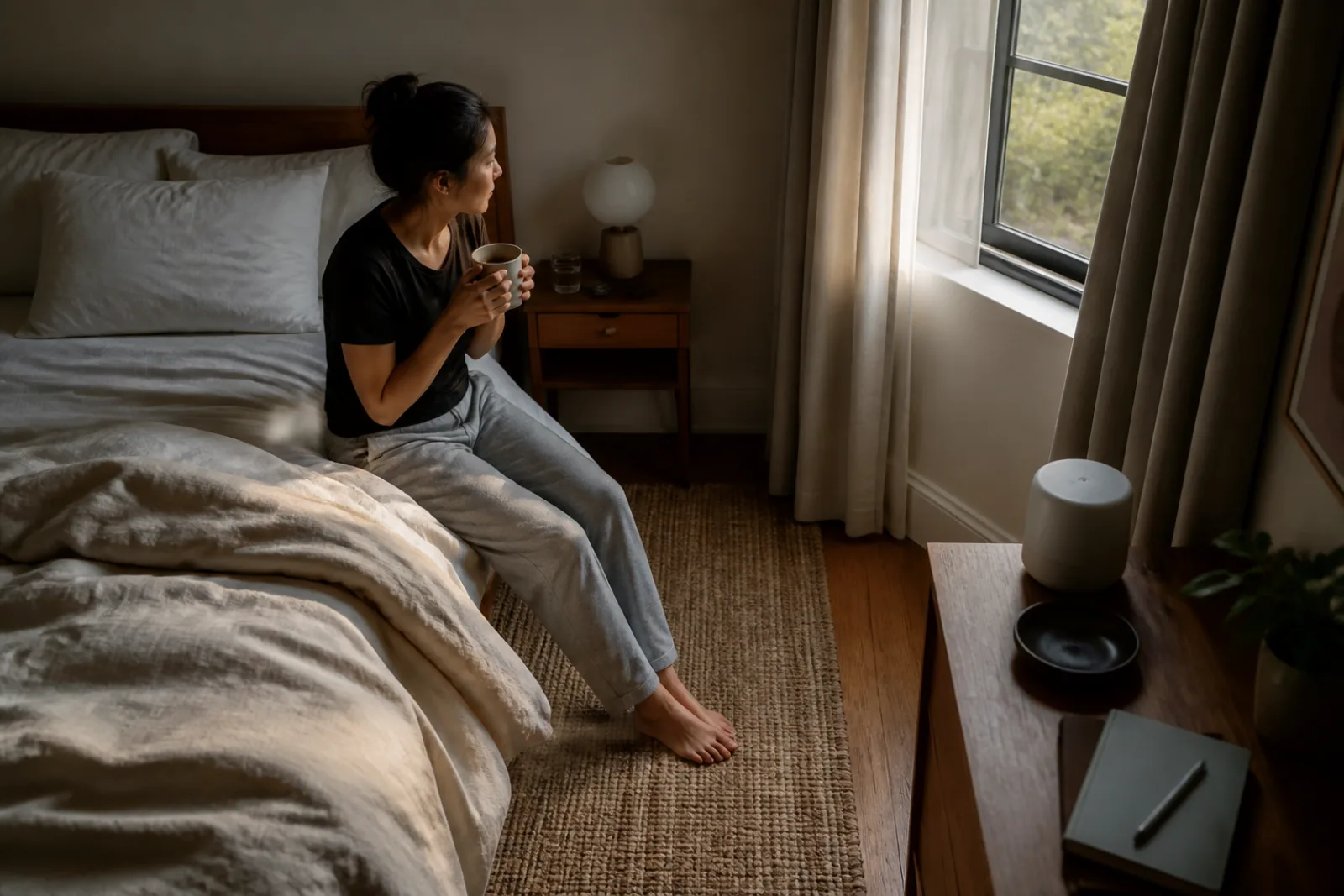
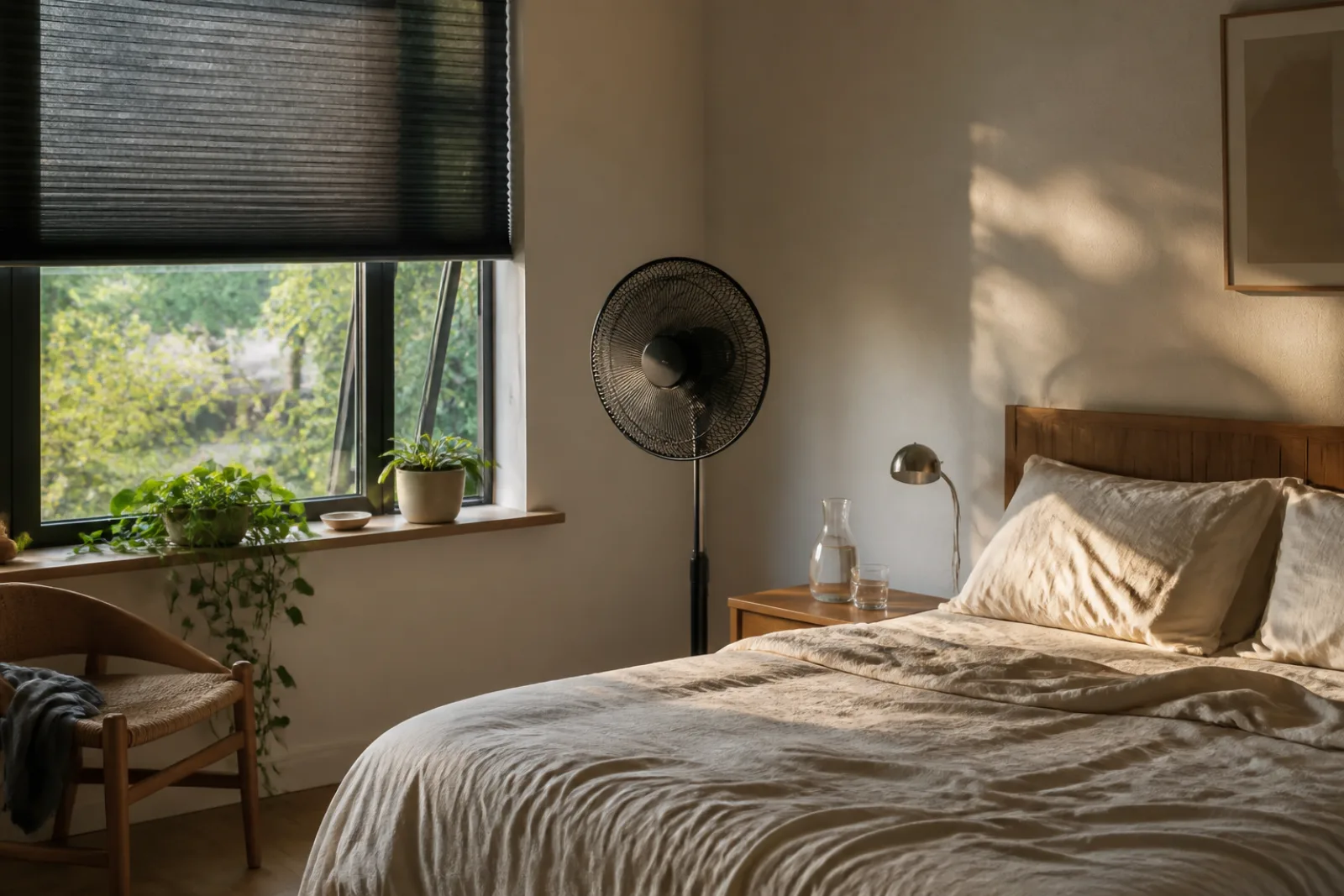
A hot bedroom at 11 p.m. is often a room that took a beating at 4 p.m. Sun on glass, closed windows, and a mattress that holds what the body puts into it will still be radiating after the outdoor air has dropped. NHLBI's sleep habits include a cool room. They do not ship you a compressor. If you cannot add air conditioning, you work the heat that is already there: keep it out during the day, dump it when the night air is actually cooler, and stop wrapping yourself in a wet synthetic burrito.
This is not the article on dark and quiet, and it is not the article on bedroom air quality. It is the heat problem in isolation, because that is the one people try to solve with a pillow that promises a technology.
Cool the night by starting in the afternoon
- 01Before the sun hits the glass hard
Close opaque shades or curtains on the hot exposures. A dark room in the day is a cooler room at night. Sheer daytime curtains are a view, not a shade.
- 02While the outdoor air is still hotter
Keep windows closed if you have any cooler indoor mass to protect. Running a fan in a sealed, already-hot room only stirs hot air and adds a little motor heat.
- 03When outdoor air drops below indoor air
Open for a cross-breeze if the air is safe and not full of wildfire smoke or roar. A window fan blowing out on the hot side and an inlet on the cool side is the apartment version of DOE's whole-house-fan idea: replace indoor air with cooler outdoor air.
- 04At the bed
Aim a fan across the body so sweat can evaporate. Lighter, drier sheets. Less foam hugging the back if you sleep hot.
Fans cool skin by evaporation and by replacing the bubble of air your body has already heated. That is why a fan aimed at the wall art does little, and why a fan in high humidity feels weaker: sweat cannot evaporate as easily. In humid weather the honest tools are less bedding, a slightly higher air speed, and, if you have it, any dehumidification. A mister or a damp sheet in still, humid air can make the bed clammy without making you cooler.
DOE's note on whole-house fans is the right physics at a smaller scale. Those fans are for hours when outdoor air is cooler, typically night. They are not for a 95°F afternoon. If the street is hotter than the bedroom, opening the window is how you import the problem. Check. Use a cheap thermometer in the room and one at the window if you are guessing.
The mattress is a heat battery. Memory foam in particular holds what you put into it. A white 'cooling' cover cannot repeal that if the foam is still against you. Breathable sheets (cotton, linen) that you can wash, a lighter blanket, and a gap under a too-hot duvet beat a gadget you will still sleep on top of foam with. If you can raise the bed slightly for air under it, do. If you cannot, do not buy a second mattress to solve a shade-and-fan problem.
| Move | When it helps | When it does not |
|---|---|---|
| Close shades on the sunny wall by mid-afternoon | Almost every sunny climate | A north room with no solar gain; then skip it |
| Window fan / cross-breeze at night | Outdoor air cooler and acceptable quality | Heat wave nights, wildfire smoke, unsafe windows |
| Pedestal fan aimed at the sleeper | Dry or moderately humid rooms, always as skin cooling | As a 'room AC' in a closed hot box |
| Lighter, washable sheets | When you wake damp | When the room air is 85°F and still; you still need air movement |
| A cooling mattress pad that needs a hose and a tank | If you already did shade and airflow and still sleep hot | As the first purchase while the west window bakes uncovered until sunset |
Stop the heat before bedtime
- 01
Shade the glass while the sun is still working. Night is too late to refuse today's solar gain.
- 02
Move cooler outdoor air in only when it is actually cooler. Aim fans at people.
- 03
Dry, lighter bedding and less foam-against-skin beat a cooling slogan on a hot mattress.
Questions
- 01Should I ice the sheets or sleep with a frozen water bottle?
A bottle of frozen water at the feet or in front of a fan is a short, local trick. Wet sheets in humid air can feel worse. Do the shade and the window timing first; ice is a garnish.
- 02Is 65°F the required sleep temperature?
Some sleep clinicians like a range in the 60s. NHLBI's public page just says cool. If you cannot reach the 60s, get as much shade, night air, and airflow as you can. Do not treat a number you cannot hit as a reason to do nothing.
- 03The upstairs bedroom is always hotter.
Heat rises and roofs take sun. Shade, night purge, and a fan are still the tools. If you can sleep downstairs on the worst nights, that is a layout solution, not a failure of character.