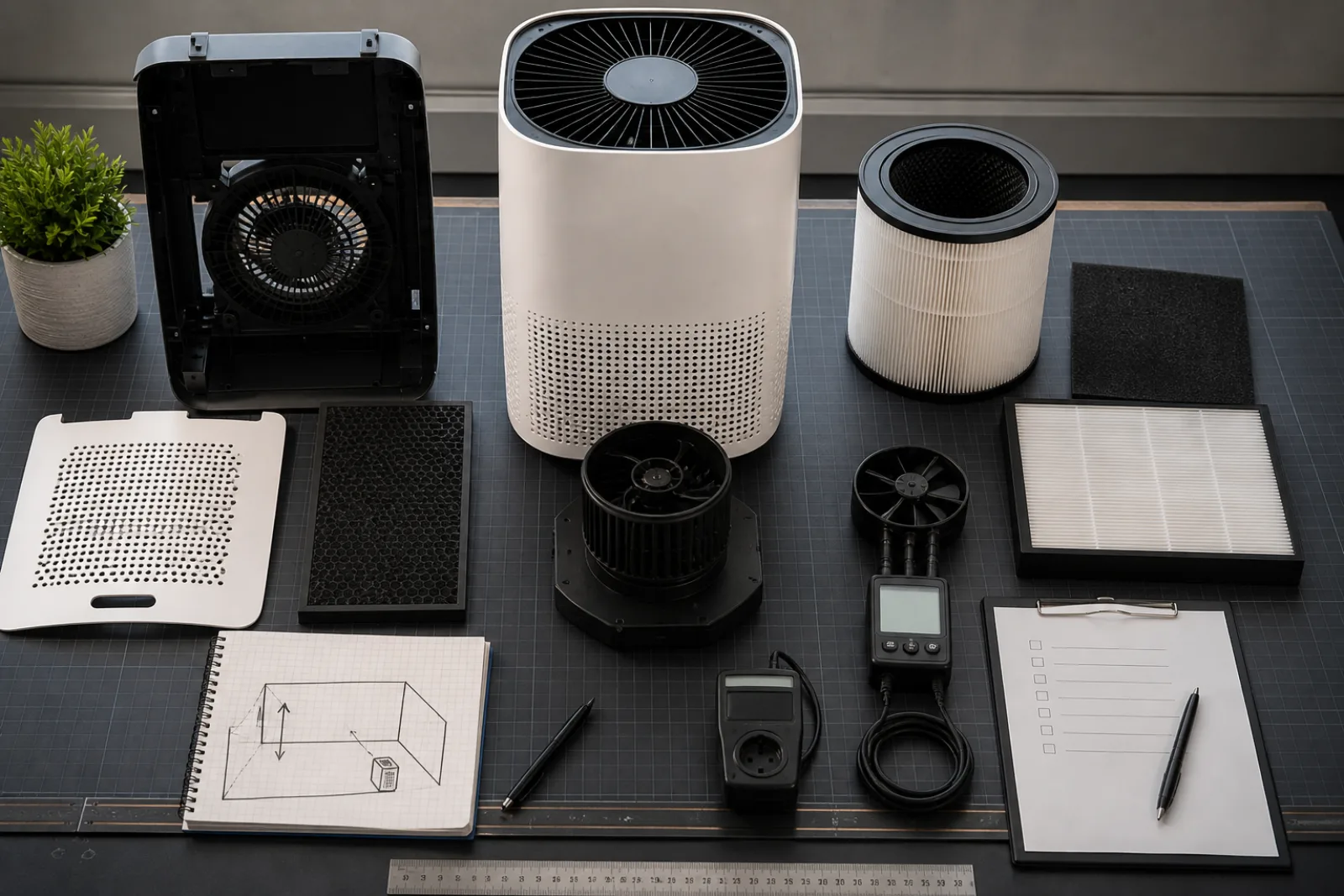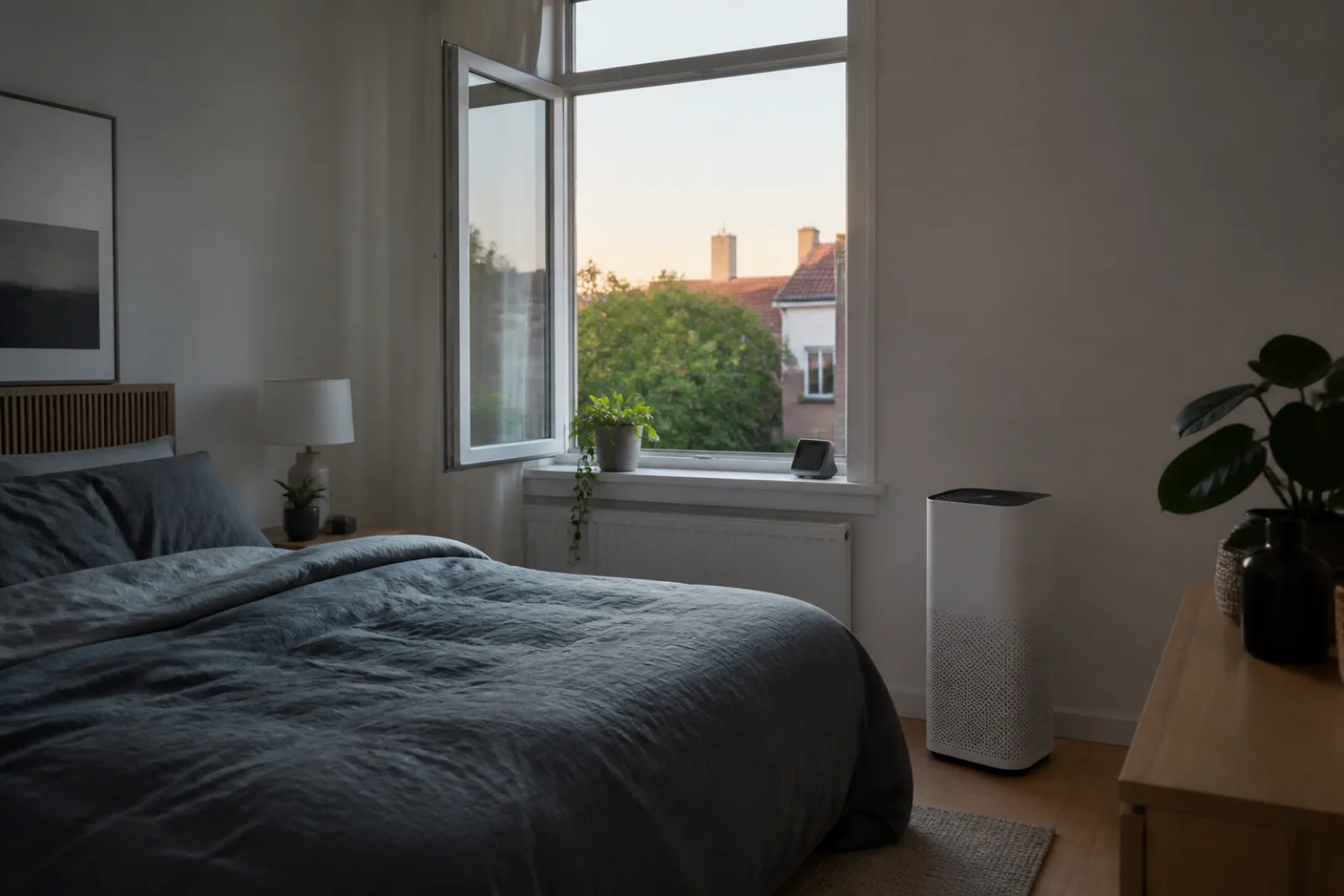
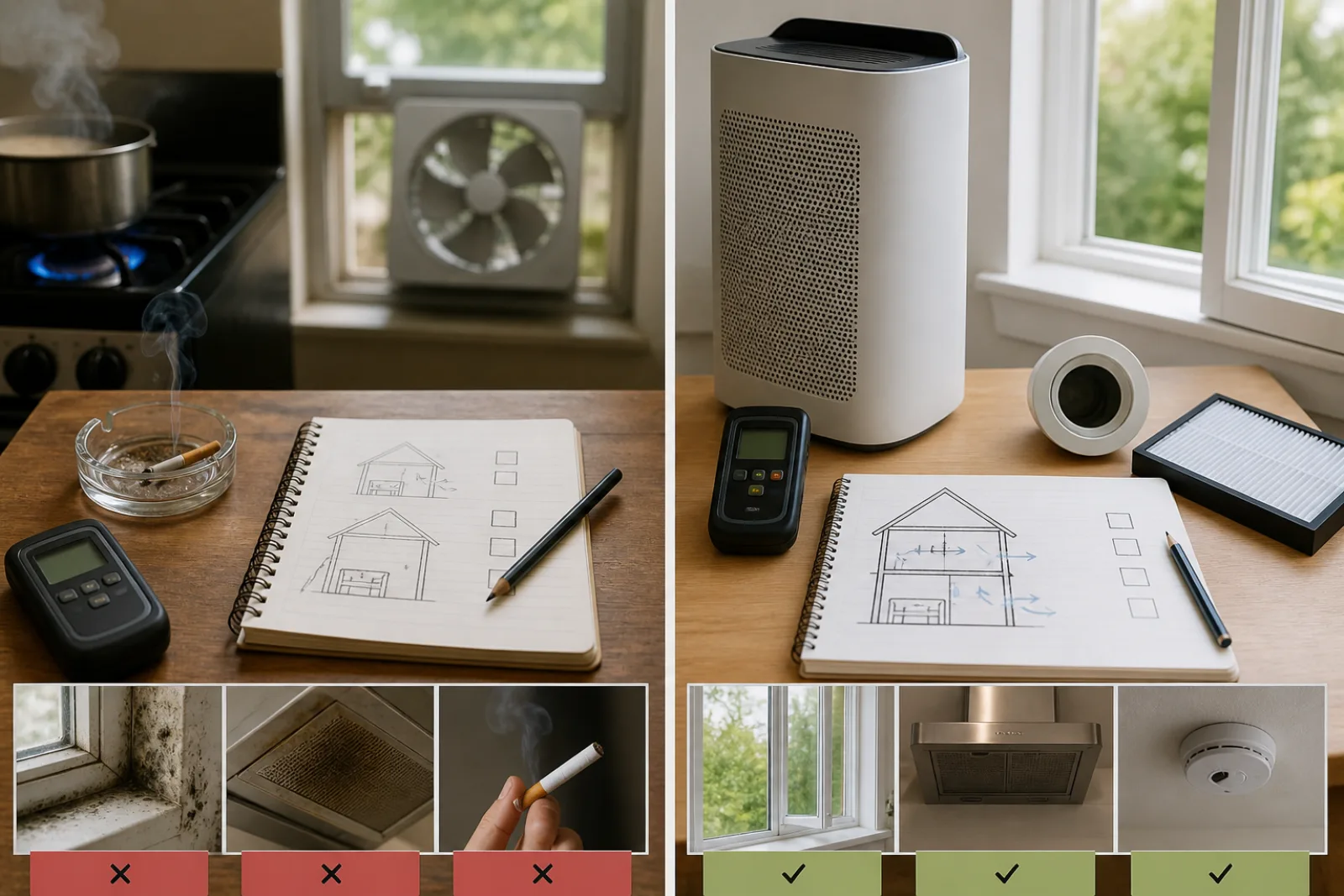
The market for indoor air is a tower of boxes that promise hospital air in a studio apartment. The Environmental Protection Agency's actual sequence is less photogenic. First, stop making the pollution, or make less of it. Second, dilute what you cannot stop, with outdoor air that is itself reasonably clean. Third, if particles are still a problem in a room you live in, a filter that moves enough air can help. That third step is optional in the sense that it does not replace the first two. It is also the only step you can impulse-buy.
This page is the decision to use filtration at all. Matching a specific unit's Clean Air Delivery Rate to a room is the Reviews companion, How to choose a room air cleaner. If you skip this page, you can buy a correctly sized cleaner for the wrong problem.
EPA's three strategies, in the order they prefer
- 01Source control
Eliminate or reduce emissions. Smoke outdoors. Fix the gas range so it burns cleanly and exhaust it. Dry the wet drywall. Choose materials that off-gas less. EPA: usually the most effective, and often cheaper than running more ventilation.
- 02Ventilation
Bring in outdoor air and exhaust the dirty air. Open windows when outdoor air is acceptable. Run kitchen and bath fans that actually duct outside. Most U.S. forced-air systems do not mechanically supply outdoor air. If outdoor air is smoke or a busy road, ventilation can import the problem.
- 03Air cleaning
A portable unit filters a room. A better furnace filter (EPA suggests at least MERV 13 if the system can take it) filters whatever air the HVAC actually moves. Effectiveness is collection efficiency times airflow. A tight filter that barely moves air, or a roaring fan with a weak collector, both fail.
Name the pollutant before you name the product
What are you actually trying to reduce?
- 01Particles (smoke, pollen, dust, cooking aerosol, PM2.5)
A portable cleaner with a CADR matched to the room, run at a speed you will tolerate, in the room you occupy. Or a higher-MERV HVAC filter if the system runs often enough. Still: stop the source if you can.
- Wildfire smoke or a neighbor's cigarette you cannot stopFiltration is on-mission. Size CADR to the space. Close windows while outdoor particle counts are high.
- You cook a lot on a gas or high-heat panExhaust outdoors first. A cleaner in the living room will not catch a plume at the stove as well as a hood that vents.
- 02Gases and odors (formaldehyde, some VOCs, cooking smell)
EPA: most air cleaners are not designed to remove gaseous pollutants. CADR does not measure gases. A thick activated-carbon bed can help some gases. Plasma, photocatalytic, and UV claims for residential gas removal are not something EPA's consumer guide treats as demonstrated.
- New furniture or paintVentilate, delay occupying the room, choose lower-emitting materials next time. Do not expect a tabletop ionizer to eat formaldehyde.
- 03Mold, musty odor, or a wet wall
EPA: portable cleaners and HVAC filters do not address the cause. Remove moisture, clean mold, fix the leak. A filter may catch some spores and take the edge off odor. It will not dry the house.
- You can see growth or the drywall is wetThis is a building problem. Buy a dehumidifier or a contractor, not a HEPA as the plan.
- 04Radon
EPA does not recommend air cleaners to reduce radon and its decay products. They only partly remove decay products and do not stop radon entering. Test and mitigate the soil-gas path.
- A test is highFollow EPA radon mitigation guidance. A portable purifier is a distraction.
EPA's consumer guide is blunt about what filtration can do for health: possibly small improvements in some cardiovascular, respiratory, allergy, or asthma measures in studies that used portable HEPA cleaners. The improvements are typically small and not always noticeable to the person in the room. That is not a reason to skip a well-sized cleaner if particles are the issue. It is a reason not to sell yourself a medical device.
Houseplants are not a strategy. EPA's improving-IAQ page says there is currently no evidence that a reasonable number of houseplants remove significant quantities of pollutants in homes and offices, and overwatering can grow microorganisms. The NASA chamber studies were not your living room.
Ozone is a lung irritant. EPA tells people to avoid portable cleaners and HVAC gadgets that intentionally produce ozone. Some electrostatic precipitators, ionizers, poorly coated UV lamps, and plasma units can emit ozone even when ozone is not the marketing headline. California's Air Resources Board and AHAM keep lists of units tested for low ozone. ENERGY STAR on the box means the motor is efficient. EPA's own disclaimer on those products says the label is not an endorsement of healthier air.
If you have decided particles in a specific room are the remaining problem, leave this page and use CADR. EPA publishes an estimation table: about 65 cfm of CADR for 100 square feet with an 8-foot ceiling, scaling linearly, with a note to go higher for taller ceilings. The Reviews article walks the two-thirds rule and smoke-CADR detail. This page's job is to keep you from using that table on a radon problem.
Filter last, on purpose
- 01
Source, then outdoor air, then a sized particle filter in the room you use.
- 02
CADR is particles. Gases, mold moisture, and radon are other tools.
- 03
No ozone generators. ENERGY STAR is watts, not CADR.
Questions
- 01Can I skip the window if I buy a strong cleaner?
EPA: filtration does not replace source control and ventilation. In wildfire smoke, you may close windows and filter. That is a bad-air-outside exception, not a lifestyle.
- 02Is a furnace filter enough?
Only while the system runs, which EPA notes is often under 25 percent of the time in heating and cooling seasons. A MERV 13 filter helps the air that actually passes through. A portable unit in the bedroom still has a job at night if the furnace is off.
- 03Where do I put it?
EPA: the room you spend the most time in, airflow unobstructed, not behind a curtain. If the jet of air is annoying, redirect it rather than turning the unit off.