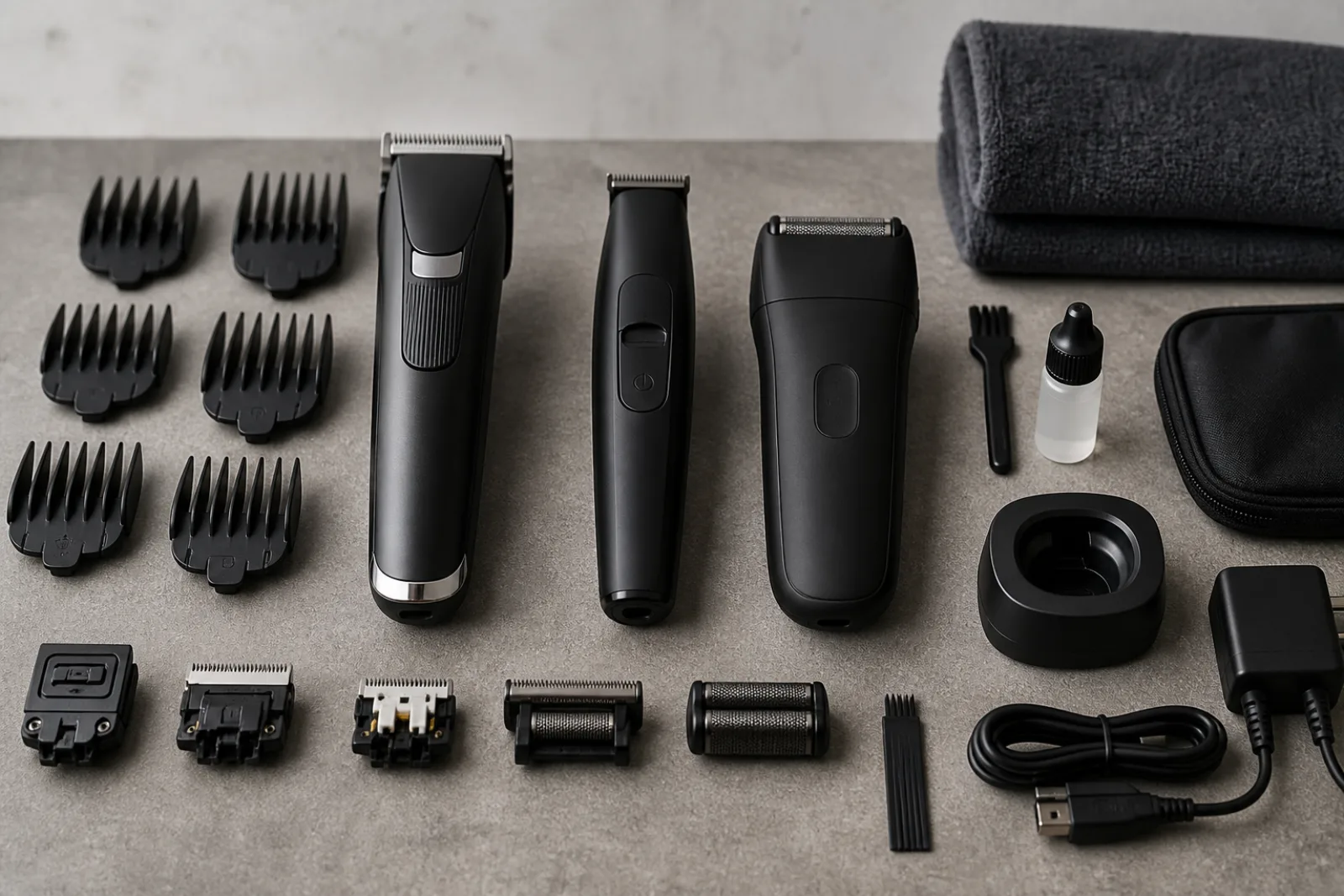
The aisle labeled trimmers sells three different machines under one word. A hair clipper is a wide reciprocating blade with plastic attachment combs that leave a measured length. A beard trimmer is usually a narrower blade, sometimes a T-blade, with millimetre click-stops or a small comb. A foil or rotary shaver is a skin-close cutter: hair enters holes in a thin metal screen and is sheared underneath. Those jobs do not share parts. A foil will not leave you a number-two buzz. A clipper will not give you a daily close shave. Culture Column has not run endurance tests, closeness trials, or battery-cycle counts on any of these tools. This is a specification reading of how the cutting systems, guard charts, and manufacturer maintenance schedules actually work.
If the box is a 'grooming kit,' count the distinct cutting heads before you count the extra combs. A kit that includes a clipper, a detail trimmer, and a foil is three tools sharing a charger. A kit that includes eight guards for one clipper is one tool with length options. The second kind is simpler to keep sharp. The first kind is simpler to abandon when one head goes out of production.
Philips describes the two skin-close families in mechanical terms, not as a brand war. A foil shaver uses oscillating blades that swing under a perforated metal foil. Hair is caught in the holes and cut as you move in straight strokes. A rotary shaver uses several circular heads with revolving blades that move independently, meant to follow jaw and neck contours, and is used in small circles so hair growing at different angles can enter the openings. Philips notes that foil heads are often discussed for daily, shorter stubble and for people who prefer a linear stroke, and that rotary heads are discussed for coarser or multi-directional growth. That is the company's product architecture, not a clinical ranking, and it is not a substitute for a clipper when you want leftover length.
A clipper is the length tool. Wahl USA's guard guide is the chart most home kits still copy: the comb number is leftover hair, not a style name. A #1 guard is 1/8 inch. A #2 is 1/4 inch. A #4 is 1/2 inch. A #8 is 1 inch. The half-size #1/2 is 1/16 inch, as short as Wahl lists before an unguarded blade. Wahl also documents a taper lever on the side of many clippers that closes or opens the blade gap between those comb steps, which is how a fade is blended without inventing a new guard. If a listing does not print millimetres or inches on the combs, you cannot plan a repeatable cut. If the comb does not lock onto the blade, the increment on the plastic is fiction the first time it pops off mid-pass.
| Category | Clipper with guards | Foil shaver | Rotary shaver |
|---|---|---|---|
| What it cuts to | A leftover length set by the attachment comb, typically 1/16 inch to 1 inch on Wahl's chart | Skin-close, hair entering holes in a thin metal foil | Skin-close, hair entering openings in circular heads |
| Stroke | Against the grain, feeding hair through the comb teeth, per Wahl | Straight back-and-forth strokes, per Philips | Small circles so multi-directional hair can enter, per Philips |
| Length control | Numbered guards plus, on many models, a taper lever between sizes | None. This is not a millimetre trimmer. | None. Some kits add a separate trimmer comb. |
| Consumable parts | Blades that are oiled, aligned or replaced; plastic combs that crack or go missing | Foil and cutter cassette. Braun: replace about every 18 months. | Cutter-and-guard heads kept as matched sets. Philips: replace about every two years. |
| Water | Many clippers must stay dry. Wahl cordless instructions: never immerse. | Washable or wet models under IEC 60335-2-8 must be at least IPX7. | Same IPX7 floor for washable or wet rotary shavers and clippers. |
Beard trimmers sit between those columns. They are not shavers. They are small clippers whose combs are marked in millimetres, often in 0.5 mm or 1 mm clicks, so a beard can be evened without jumping a full eighth of an inch. The increment is the product. A kit that only offers 3 mm, 6 mm, and 9 mm cannot blend a cheek line the way a 0.5 mm wheel can. A wheel that does not detent, or a comb that flexes away from the blade, will cut a trough you cannot undo. Check that the length is printed on the comb or in the manual, not only in the marketing copy, and that the comb locks. Brand numbering is not universal. Wahl's inch chart is a documented standard for that company's clipper combs. Another maker's 'number 2' may not be 1/4 inch. Read the millimetres on the plastic.
A T-blade trimmer is a third length tool, narrower than a hair clipper, used for edges, necklines, and beard perimeters. It is not a foil. It will not shave a cheek smooth. It will cut a line if the blade is oiled and the comb, if any, is seated. Home kits that include both a wide clipper and a T-blade are two blades to maintain. If you only ever cut a number-two all over, the T-blade is spare plastic. If you fade, it is the tool that cleans the edge the wide blade cannot reach. Confirm the T-blade is a spare you can still buy. A riveted edge trimmer on a sealed handle is a disposable outline tool.
- #1/2
- 1/16 inch
- #1
- 1/8 inch
- #2
- 1/4 inch
- #3
- 3/8 inch
- #4
- 1/2 inch
- #5
- 5/8 inch
- #6
- 3/4 inch
- #7
- 7/8 inch
- #8
- 1 inch
Wahl USA, Ultimate Guide to Hair Clipper Guard Sizes. These are leftover lengths for Wahl attachment combs, not a ranking of clippers, and not a guarantee that another brand's numbered guards match.
Maintenance is not optional on a reciprocating blade. Wahl's cordless-clipper instructions are specific: after each use, clean the blades and put a small drop of clipper oil between them while the tool is running, then wipe the excess so oil does not run into the motor. Do not store the tool wet. Never immerse it. That oiling step is the difference between a blade that still cuts in year three and a blade that pulls. Foil and rotary systems are different scissors. Braun tells owners that a foil and cutter block should be replaced about every 18 months, and that in that interval a shaver cuts an average of six million hairs. Philips rotary manuals tell owners to replace the shaving heads about every two years, to replace damaged heads immediately, and to keep each cutter with its matching guard because mixed pairs can take weeks to recover even cutting. Those intervals are the real cost of the handle. Before you buy, search whether the foil cassette, rotary heads, or clipper blade for that exact family is still sold as a spare. A sealed 'self-sharpening' claim with no spare-parts page is a disposable motor.
Water ratings are a safety class, not a cleaning personality. IEC 60335-2-8, the particular safety standard for shavers, hair clippers, and similar appliances, requires washable and wet shavers, clippers, and epilators to be at least IPX7, with fixed parts and detachable power supplies at least IPX4. Instructions for washable units with detachable cords must tell you to detach the hand-held part from the supply cord before cleaning it in water. A clipper whose manual says keep dry is not a shower tool, no matter how many 'wet/dry' kits sit next to it on the shelf. If you want to rinse the head under a tap, the IP rating and the detach-before-rinse warning have to be in the manual, not inferred from a bathroom lifestyle photo.
Each cutting family has a different wear part. The handle is only useful while that part is still sold and still fits.
- 01Clipper blade
Two toothed blades that shear hair. Oil the gap after every use per Wahl. Hair packed in the teeth makes the motor work hotter and the cut uneven.
- 02Attachment comb
Sets leftover length. Must lock. Numbered in inches on Wahl clippers, often in millimetres on beard trimmers. Lost combs are a new kit.
- 03Taper lever
On many clippers, a side lever that opens or closes the blade between guard sizes so a fade can be blended.
- 04Foil and cutter
Thin perforated screen plus oscillating cutter. Braun: replace the cassette about every 18 months. A torn foil is a skin hazard, not a 'still sharp' blade.
- 05Rotary heads
Cutter and guard as a matched set. Philips: do not mix cutters across guards. Replace the set about every two years, sooner if damaged.
- 06Battery and cord
Cordless lithium, corded-only, or cord/cordless. Wahl documents using the transformer on the tool when the cell is low. A glued-in pack with no spare is the end of the handle.
Power is a runtime and a failure mode, not a closeness upgrade. A corded clipper does not die in the middle of the second side of a head. A cordless lithium pack does, unless the maker documents a corded fallback. Wahl's cordless instructions say the transformer can attach to the unit so you can keep cutting as a corded tool if the battery is low, and that a fully depleted pack should charge for a minute, switched off, before that corded use. That fallback is a spec you can look for. Cordless-only handles without a published spare battery are a timed motor. Lithium cells also have a safety record that is not theoretical. In June 2024 the U.S. Consumer Product Safety Commission announced a recall of about 50,000 StyleCraft Instinct Professional Vector Motor cordless clippers, model SC607M, because the lithium-ion battery could overheat, with six reports of overheating or fire and one minor burn. A recall of one professional model is not an indictment of every cordless clipper. It is a reminder that the cell is a wear and hazard part, that lot numbers matter, and that a replaceable pack you can stop charging is preferable to a sealed handle you can only throw away.
Nose, ear, and body attachments in a kit are separate cutters with separate hygiene rules. A rotary or foil face shaver is not a nasal trimmer. A plastic nose wand that you cannot detach and rinse is a bacteria trap. If the kit includes those wands, confirm they come off the handle and that the manual allows rinsing. Do not assume IPX7 on the face head extends to every snap-on piece. Body-grooming combs are length tools again: millimetre settings, a blade you can oil or replace, and a skin-safe foil if the job is a close body shave. Mixing a hair-clipper blade on body skin without a comb is how people get ingrown hairs and nicks. The spec sheet will not diagnose your skin. It will tell you whether the head you need is in the box and still sold as a spare.
Runtime claims on the box are manufacturer numbers, not Culture Column measurements. What you can check is whether the listing states a charge time, whether the tool can run while plugged in, and whether the charger is a proprietary stand or a USB cable you already own. A stand that is the only way to charge a unique pin-out is another lock-in, the same way a foil cassette is. If you travel, a USB-chargeable trimmer with a published IP rating and a spare comb set in the case is a different product from a full-size corded clipper that lives on a bathroom hook.
Which cutting system the job actually needs
Do you need leftover length you can repeat (a numbered buzz or an even beard), or a skin-close shave?
- 01Length or skin-close
A guard or millimetre comb is a length tool. A foil or rotary head is a shave. Buying the wrong family cannot be fixed with extra attachments.
- I want a repeatable leftover length on hair or beard
- I want a daily or near-daily skin-close shave
- 02Are the length steps printed, and do the combs lock?
Wahl clipper guards are documented in inches. Beard trimmers should show millimetres, including half-steps if you blend. A comb that does not lock is not a length setting.
- Yes: numbered or millimetre combs that lock, plus a published oiling or blade-replacement path
- No printed lengths, or combs that clip on looselyKeep looking. Extra unnumbered plastic in the box is not a cutting system.
- 03Foil or rotary, and are replacement heads still sold?
Philips: foil is a straight-stroke, perforated-screen cutter; rotary is independent circular heads. Braun: replace foil and cutter about every 18 months. Confirm the cassette or head family for that exact handle.
- Heads are sold as spares for this handle family, and the wet/dry IP rating matches how I will rinse it
- No spare-head listing, or a wet-use claim with no IPX7 language in the manualTreat it as a disposable gadget. A torn foil or a drowned motor is not a close shave.
- 04Corded, cordless, or both?
A cord never dies mid-cut. Cordless is useful if the maker documents a corded fallback or a replacement pack. Check CPSC.gov for the model before you buy a lithium handle.
- Corded, or cordless with a documented corded fallback or spare packBuy that cutting system. Oil or replace on the maker's schedule. Do not expect a clipper to shave like a foil, or a foil to leave a number-two length.
- Sealed cordless-only pack, no spare, no recall checkWalk away unless you accept a timed motor. The cell is the product.
Before you buy
- 01
Name the job: leftover length (clipper or millimetre trimmer) or skin-close (foil or rotary). A kit that blurs those jobs is three wear parts, not one bargain.
- 02
Confirm printed guard or millimetre increments that lock, plus a published oiling or head-replacement schedule you can still buy parts for.
- 03
Prefer corded or cord/cordless with a documented fallback. Check CPSC.gov for the model if the handle is lithium.
Questions
- 01Can one grooming kit replace a clipper and a shaver?
Only if it actually includes both cutting systems and you will maintain both. A clipper with guards will not shave as close as a foil or rotary head. A foil will not leave a numbered buzz. Count distinct heads and spare-part listings, not the number of plastic combs in the case.
- 02Do I need a washable, wet/dry model?
Only if you will rinse it or use it with foam in the shower. IEC 60335-2-8 sets IPX7 as the floor for washable and wet shavers and clippers. Wahl's dry clipper instructions say never immerse. Match the manual to the sink, not the lifestyle photo.
- 03How often do blades or foils need replacing?
Wahl: oil clipper blades after every use; replace when they pull or you cannot restore the cut with cleaning and oil. Braun: replace foil and cutter about every 18 months. Philips rotary: replace shaving heads about every two years, or immediately if damaged. Those are manufacturer schedules, not Culture Column wear tests.