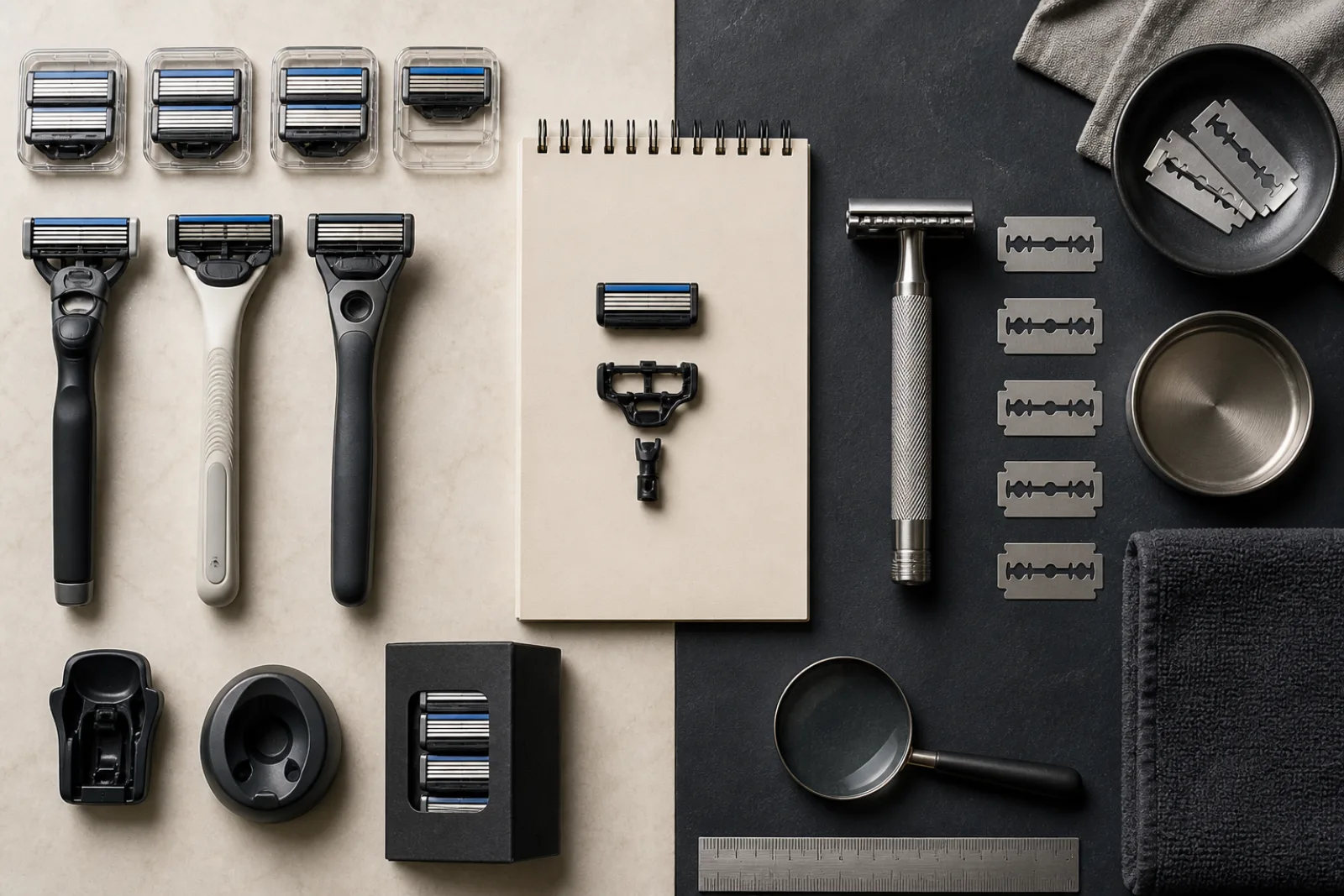
The drugstore invented a word that sounds like thrift. Refillable. What it usually means is: keep the plastic or metal stick, throw away a cassette that only that stick will accept. Gillette did not hide this a century ago. The handle is the bait. The blades are the business. Multi-blade cartridges, vibrating handles, and lubricating strips are later costumes on the same contract.
A double-edge safety razor is a different contract. The blade is a thin rectangle with two edges. It fits Merkur, Henson, Leaf (in DE mode), and a pile of no-name butterflies. You are not loyal to a SKU. You are loyal to a size. That is the choice hiding under refillable.
| Architecture | What you refill | Who can sell you the next edge | Typical cost shape |
|---|---|---|---|
| Disposable | Nothing. The whole razor is trash. | Anyone with a blister pack | Cheap per unit, expensive if you shave often, and a bin of plastic. |
| Proprietary cartridge (most 'refillable' kits) | A head that clicks only onto that family's handle | That brand, and sometimes a licensed lookalike. Not a DE blade. | Handle is often a few dollars. Cartridges are dollars each. Year cost is the real price. |
| Double-edge safety razor | A standard DE blade | Dozens of blade makers. The handle is a one-time tool. | Handle costs more up front. Blades are cents. Technique is the tuition. |
Culture Column has not audited 2026 drugstore prices. The shape is stable enough to state without a fake spreadsheet: a four-pack of name-brand multi-blade cartridges is often the price of a hundred-pack of DE blades. Your year cost is shaves times how fast the edge dies, which is hair, pressure, and whether you dry the head. How to know when to replace a razor blade is that wear test. Do not use a box's 'up to twelve shaves' as a specification.
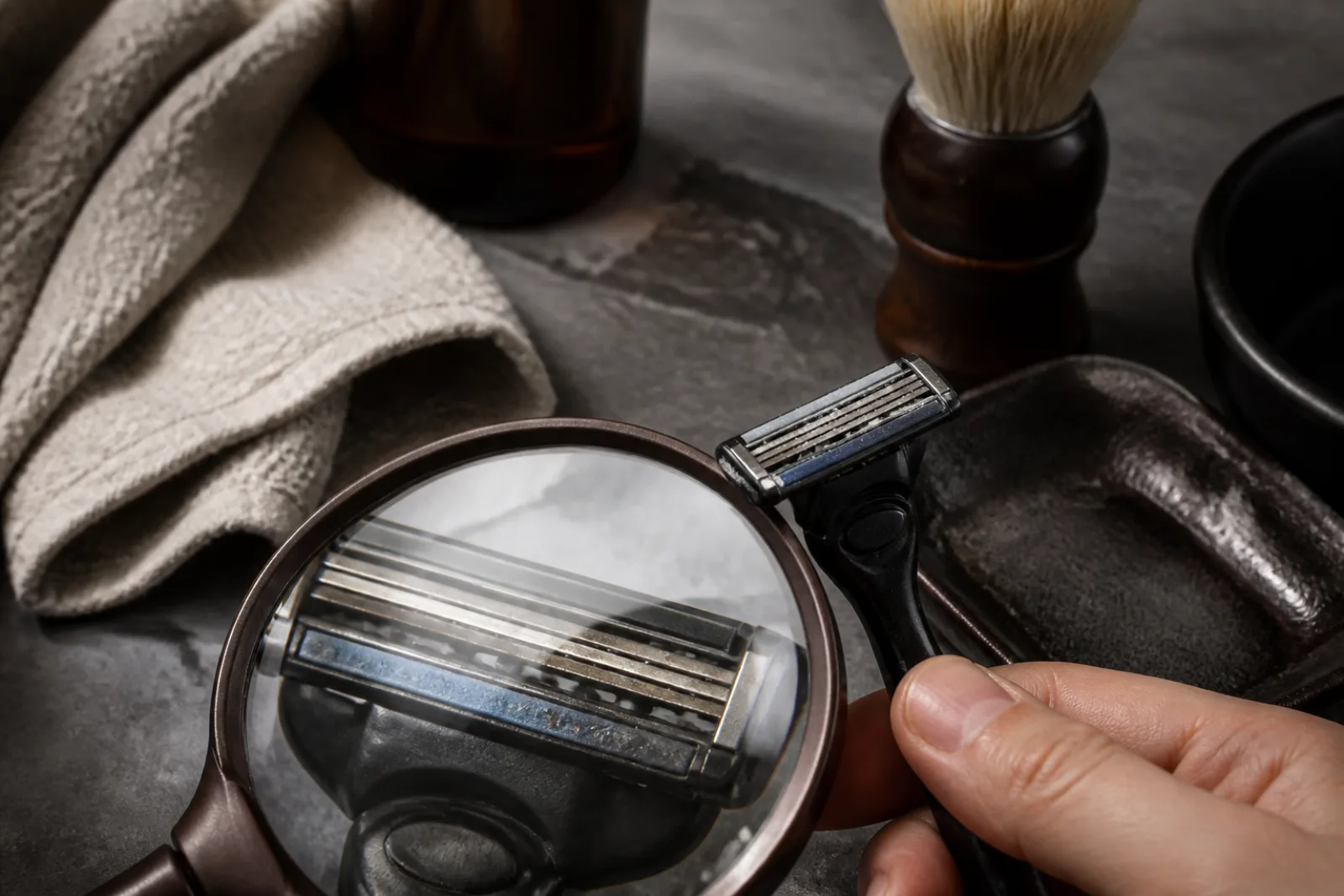
Cartridge heads clog. Hair and soap sit between stacked blades. If you cannot see daylight through the cassette after a rinse, you will shave with yesterday's paste. A DE blade rinses in one motion. That is not romance. It is geometry.
A heavier handle can feel expensive and still shave like a cheap one. Mass does not sharpen steel. It can reduce chatter if you already use almost no pressure. It cannot rescue a dull cartridge.
Travel, then lock-in, then the sink
Where will this razor actually live?
- 01Carry-on only, no checked bag
TSA allows disposable razors in the cabin. A safety razor may go through screening only with the blade removed. Officers will not pull the blade for you. Loose DE blades are not a cabin item.
- I fly with a personal item and still want to shaveCartridge or disposable in the toiletry bag, or a bladeless DE handle plus blades bought at the destination. Do not argue the checkpoint with a loaded butterfly.
- 02I will check a bag, or I barely fly
DE blades in the hold, sheathed or in their paper wrappers inside a tin. Handle can ride in either bag once empty.
- I refuse proprietary refillsBuy a DE razor and a sampler of blades. The first month is practice, not a referendum on your face.
- 03I want the shave I already know
A cartridge handle is honest if you price a year of that brand's heads before you fall for the $8 starter kit.
- The club sends blades on a scheduleThat is a subscription. Cancel through the same account that bills you. Deleting the app does not stop the box.
- Cartridge compatibility
- Name the exact head (Mach3, Fusion, Hydro, Harry's, and so on). If the page says 'fits most' without a list, assume it fits none of the ones you already own.
- DE vs SE vs cartridge
- Double-edge is the open rectangle. Single-edge (Injector, GEM) is another standard, not a DE. Do not mix them.
- Rinse path
- Open comb and a single blade rinse. Five-blade cassettes need a tap and patience. If you have hard water, dried soap is a second blade.
- Replacement cost, not handle cost
- Price a year's heads at your actual shave frequency. The $12 handle is a rounding error on a $200 cartridge year.
TSA pages cited above cover travel only. Compatibility and cost are how the SKU is sold, not a lab result.
If you already own a cartridge handle you like, the refillable decision is whether to stay in that family's heads or to pay the DE learning tax. There is no moral prize for either. There is a spreadsheet and a suitcase. Do both before you buy a heavier stick that still takes the same $4 cassette.
Buy the refill, not the handle photo
- 01
Proprietary click is lock-in. DE is an open blade size.
- 02
Price a year of edges. Ignore the starter-kit handle.
- 03
Cabin travel favors cartridges and disposables. DE blades go in the hold.
Questions
- 01Is a metal cartridge handle 'refillable' in the same way as a safety razor?
Only in the sense that you keep the stick. The head is still a proprietary part. Metal does not open the standard.
- 02Will a DE razor cut me more?
It can, while you learn angle and pressure. It can also cut less once you stop scraping. We have not tested that on your face. Start with a mild head and short strokes.
- 03Can I put DE blades in a cartridge handle?
No. Different geometry. Do not improvise.