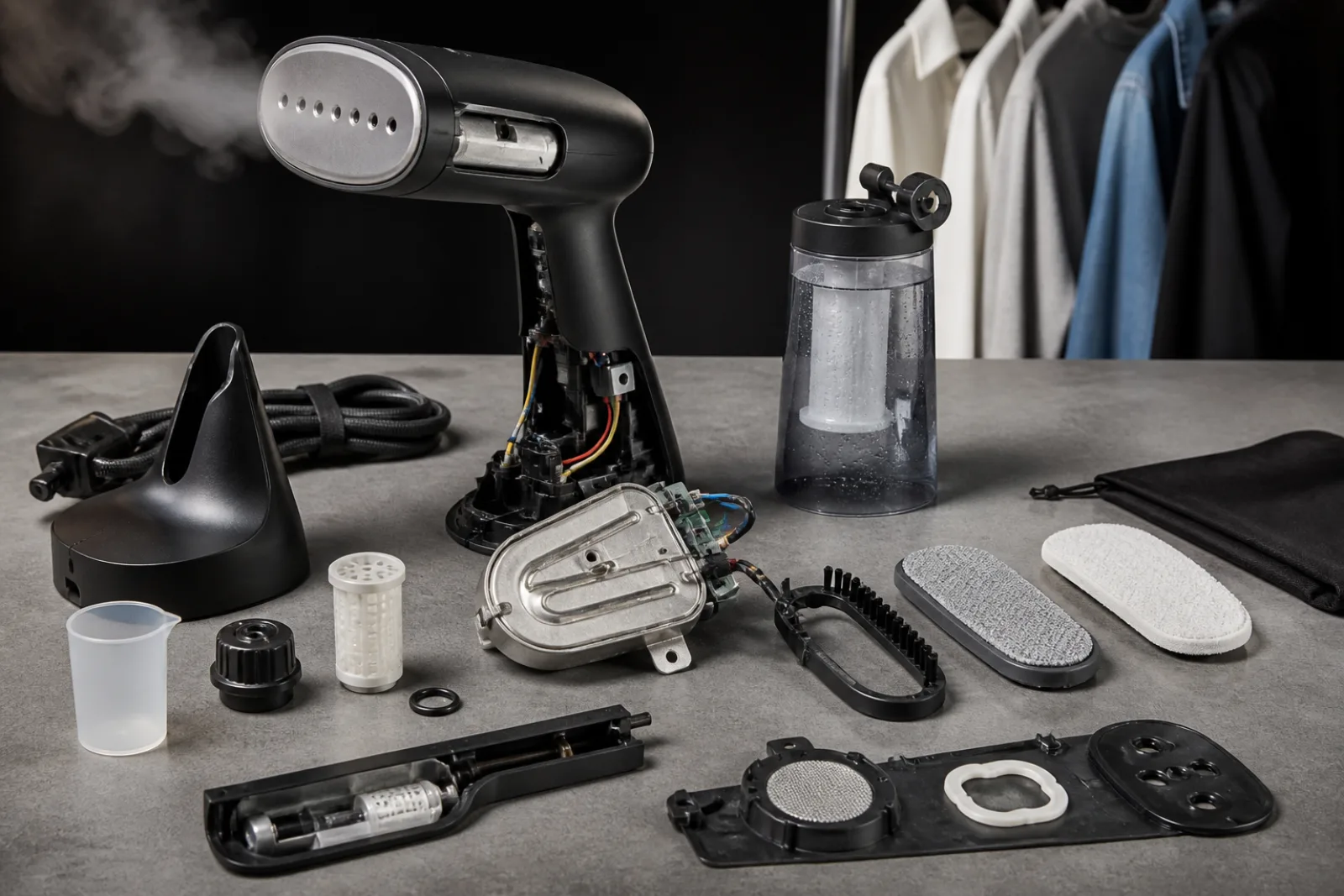
A garment steamer is not a small iron. An iron presses a crease against a board. A steamer hangs the garment and drives steam into the fibers so wrinkles relax without that pressure. The box will quote a steam rate in grams per minute and a heat-up time in seconds. Those numbers are manufacturer claims. They are not a standardized wrinkle score, and they do not tell you whether the nozzle will spit boiling water onto a wrist. Culture Column has not measured steam output or scaled tanks. This is a specification reading of how steamers are built, what IEC 60335-2-85 requires of them, and what CPSC recalls have already documented about hot-water expulsion.
The care label on the garment is still in charge. The FTC Care Labeling Rule says ironing must be mentioned if it is needed regularly, and it uses warnings such as 'Do not iron.' For drycleaning, the rule's own example of a steam warning is 'Professionally dryclean. No steam.' A home steamer is still steam. If the label forbids heat or steam, this tool is the wrong tool. How to read a garment care label is the article for symbols and the reasonable-basis test behind them. This page is the steamer as a machine.
IEC 60335-2-85 is the particular safety standard for electric fabric steamers. It is not the iron standard (that is IEC 60335-2-3) and it is not a performance contest. The 2022 edition covers household fabric steamers up to 250 V, including some DC and battery units, and it distinguishes architectures. A vented steamer makes steam when water hits a heated nozzle, with the reservoir at atmospheric pressure. A pressurized steamer uses a boiler above 50 kPa. Those are different vessels. Pressurized units have extra pressure-relief and filling-aperture rules. Vented handhelds are the ones that dominate the impulse aisle. The clause that should govern a buying decision is the construction requirement that there be no spillage of water and no sudden jets of steam or hot water likely to expose the user to a hazard in normal use. Instructions must include filling, cleaning, and descaling, must tell you to unplug during filling and cleaning, and must say not to use the appliance if it has been dropped, is damaged, or is leaking.
That 'normal use' sentence is why grams per minute is a weak buying number. A high claimed rate can be a wet, sputtering jet. A lower continuous rate from a head that stays in a rest cradle may be the tool you will actually finish a shirt with. Rowenta, as one example of manufacturer copy, advertises heat-up around 45 seconds and continuous output in the 30 to 42 g/min range on named upright models. Those figures describe those models' marketing. They are not a category standard, and they are not a CPSC test.
| Category | Handheld (usually vented) | Upright with pole and hose |
|---|---|---|
| Where the water lives | A small tank in the handle or body, often 150 to 400 ml | A larger tank at the base, often a litre or more, sometimes refillable during use |
| How steam is made | Typically vented: water meets a hot plate or nozzle at atmospheric pressure | Vented with a hose, or pressurized boiler. Check the manual's architecture, not the lifestyle photo. |
| Heat-up | Often under a minute on manufacturer claims, because the plate is small | Also often advertised around 45 seconds on specific models, then limited by hose length and pump prime |
| Rest position | A heel, hook, or cradle that keeps the hot plate off the bed and off the garment. If there is none, you are holding a hot wet iron in mid-air. | A hanger on the pole. The head should clip or hang so the hose is not kinked and the plate is not face-down on cloth. |
| Cord and hose | A power cord you must keep out of the steam path. Swivel at the handle matters. | A hose that kinks, plus a cord to the base. Hose control is the upright's extra skill. |
| What the CPSC recalls were | Handhelds that spat or leaked hot water from the nozzle during heat-up or use | Different failure modes exist (cords, boilers). The 2024 mass recalls named handhelds. |
Spitting is not a personality trait of cheap steam. It is a documented burn mechanism. In February 2024 the CPSC announced that Vornado was recalling about two million Steamfast, Vornado, and Sharper Image handheld garment steamers because they could expel hot water from the steam nozzle while heating or during use. The commission recorded 122 reports of spraying or spitting, including 23 burn injuries. A separate expansion covering BLACK+DECKER HGS011 Easy Garment Steamers, including units repaired after a 2022 recall, cited hundreds of additional hot-water incidents and dozens of burns, and changed the remedy to a refund. Those recalls are not a league table of surviving brands. They are the reason you search CPSC.gov for the model number before you plug a steamer in, and the reason a rest position and a nozzle that does not face your other hand are design, not niceties.
Heat-up time is useful only as a wait you will actually observe. A plate that is not yet at temperature throws wet water. That is one path to the spit the recalls describe. If the listing boasts 15-second heat-up, treat it as a claim and still wait for a dry, continuous plume before you point the head at a shirt, or at a child walking past. Refill design is the other half of that wait. IEC's instruction to unplug during filling exists because people otherwise pour water into a live, steaming aperture. A tank you can lift out and fill at the sink, then click back onto a cool, unplugged body, is a different product from a cap on a hot handle that you hold under a tap. Continuous-refill upright tanks are convenient for a long session and still require the unplug-or-cool discipline the manual prints.
Filling and resting without turning the steamer into a kettle aimed at your wrist
- 01Unplug first
IEC 60335-2-85 requires instructions to unplug during filling and cleaning. Do not pour into a live, steaming fill hole.
- 02Use the water the manual names
Rowenta's manuals, as one documented example, want untreated tap water, or half distilled if the tap is very hard, and warn that softened, bottled, filtered, scented, or boiled water can cause spitting and staining. Follow the book that came with the tool.
- 03Wait for steam, not for the LED
A ready light can precede a dry plume. Spit happens on the way up to temperature. Point the first burst at the sink, not at silk.
- 04Park on the rest
Hang the head on the pole hook or stand the handheld on its heel. A hot plate face-down on a bedspread is an iron you did not mean to buy.
- 05Descale on the printed schedule
The standard requires descaling instructions because scale is how jets become irregular. Empty the tank after use if the manual says so.
Scale is why a steamer that worked in month one spat in month six. Hard-water minerals stay behind when water becomes steam. They clog orifices, make the output pulse, and throw droplets. Rowenta's support pages are unusually explicit about water chemistry: untreated tap water is the design assumption; very hard water can be cut 50/50 with distilled; scented, softened, boiled, filtered, bottled, rain, and dryer water are listed as causes of spitting, brown staining, or premature wear because evaporation concentrates whatever was in the tank. That list is one manufacturer's. It is the opposite of the folk advice to use only distilled water in every steamer. Some irons and steamers want distilled. Some forbid it. The manual wins. What a spec sheet can show you is whether there is a drain, an anti-calc collector, or a descaling program at all. A sealed tank with no descaling path is a timed clog.
Pressurized uprights are a different commitment. IEC 60335-2-85 treats a boiler above 50 kPa as a pressurized fabric steamer, with extra rules for pressure relief and for not opening filling apertures that are under pressure during use. That is a safety class, not a wrinkle upgrade. If you buy a pressurized unit, the manual's warning not to open the boiler while hot is load-bearing. Vented handhelds fail by spitting from the nozzle. Pressurized units fail by pressure and by seals. Neither failure is described by a g/min number. If you do not want to manage a boiler, stay with a vented handheld or a vented upright and spend your attention on rest position, tank, and the recall list.
Cord and hose control is the difference between finishing a hem and steaming your own forearm. Handhelds need a cord long enough to reach a hanging garment from the outlet, with a swivel that does not fight the wrist. Uprights need a hose that does not kink when the head is at the shoulder of a dress, and a pole that does not tip when you pull. A garment clip or hanger on the pole is not a luxury. It is how you keep a second hand off the hot plate. Gloves that come in the box are an admission that steam scalds. Use them if the manual includes them. Do not hold the fabric taut with a bare thumb in the plume.
A steamer without a rest position is a hot, wet iron you are not allowed to set on the board, because there is no board.
- 01Steam head / sole
The hot face. Some are plastic steam chambers, some have a metal plate. Metal holds heat and can shine or mark if parked on a synthetic.
- 02Rest hook or heel
Where the head lives between passes. Confirm it exists and that the plate does not contact cloth or a bedspread in that position.
- 03Tank and fill cap
Removable tanks fill at the sink. Captive caps on hot handles are how people get steam in the face. Unplug first.
- 04Hose (upright)
Kinks cut steam and then dump a slug of water when they unkink. Length and flexibility are the spec. A fabric cover is not a pressure rating.
- 05Cord
Keep it out of the plume. A damaged bushing is a shock path. CPSC has recalled related steam irons for cord damage at the bushing.
- 06Pole and hanger
If the upright cannot hold a shirt without you pinching the fabric, you will put a hand in the steam. Look for clips or a rotating hanger in the parts list.
Fabric handling is why a steamer does not retire the iron. Steam relaxes. It does not press a sharp crease into a trouser leg the way a dry iron and a board do. It can leave water spots on silk, bloom on wool if you soak it, and a shine on some synthetics if a hot plate lingers. The care label is the legal minimum process the manufacturer tested. Silence about ironing, under the FTC rule, can mean a hot iron is allowed. A 'Do not iron' warning means do not iron. It does not secretly mean 'steam instead' unless the maker has evidence for that path. 'Professionally dryclean. No steam.' is a steam warning in the drycleaning process. Treat home steam with the same caution on that garment. Velvet, some beaded work, and plastic trims are where people learn this the expensive way.
Technique that the spec sheet cannot replace: keep the head moving, work from the inside of a hanging shirt when the fabric is delicate, and pull the hem taut with a clip rather than with your fingers in the plume. Start at the lowest steam setting if the tool has one. A single-speed handheld that only offers full blast is a worse match for silk than an upright with a low setting, even if the upright's g/min number is higher. Let the garment hang until it is dry before you wear it or fold it. Parking a damp steamed shirt in a bag is how you replace wrinkles with mildew. Empty the tank when you are done if the manual says to. Standing water in a warm tank is how the next session starts with a stale, sputtering jet.
Sanitize and kill-dust-mite claims on steamer boxes are manufacturer language. IEC 60335-2-85 does not certify disinfection. If you need a documented antimicrobial process, this is the wrong appliance category. If you need to de-wrinkle a hanging shirt before you leave, a steamer with a rest, a removable tank, and a model number that is not on a CPSC recall list is the right category. Search the recall database. The 2024 handheld recalls ran for years of production. A steamer bought cheap in 2019 can still be in that list.
Whether a steamer is the tool, and which architecture
What does the garment's care label allow?
- 01Care label first
FTC: 'Do not iron' is a warning. Drycleaning 'No steam' is a steam warning. How to read a garment care label covers symbols. Do not steam a garment that forbids heat or steam.
- Label allows ironing or is silent on ironing, and does not forbid steam
- Do not iron, no steam, or a trim that will meltDo not steam it. Use the labeled process, or accept the wrinkle. A steamer is not a loophole.
- 02Hanging refresh, or a pressed crease?
Steamers relax hanging cloth. Irons press creases on a board. Many trousers still want the iron.
- Hanging shirts, dresses, knits: steamer is in the right category
- Sharp creases, pleats, or heavy cotton that needs pressureUse an iron and a board. A steamer can help the hang, not replace the press.
- 03Handheld or upright, with a rest and a tank you can fill unplugged?
Search CPSC.gov for the model. Confirm a rest position, a removable or clearly instructed fill, and a descaling path.
- Model not recalled, rest exists, fill-unplugged is documented, descaling existsBuy that architecture. Ignore g/min as a safety number. Wait for a dry plume. Empty and descale as the manual says.
- Recalled model, no rest, or a fill cap on a live hot handle with no descaling pathSkip it. Spitting and scale are how these tools injure and then die.
Before you buy
- 01
Search the model on CPSC.gov. Spitting hot water is a documented burn hazard on millions of recalled handhelds.
- 02
Buy a rest position, a tank you fill while unplugged, cord or hose control, and a descaling path. Treat g/min as advertising.
- 03
Read the garment first. This tool does not override 'Do not iron' or 'No steam.' The care-label article covers symbols.
Questions
- 01Does a higher grams-per-minute rating mean fewer wrinkles?
It is a manufacturer output claim, not a standardized wrinkle test. IEC 60335-2-85 does not score wrinkle removal. A wet, high-rate jet can be the spit that caused recalls. Look for continuous, controllable steam and a rest, not a bigger number.
- 02Can I use only distilled water?
Only if that steamer's manual says so. Rowenta's documented position for several models is untreated tap water, cut with distilled if the tap is very hard, and a list of waters not to use because they cause spitting and staining. The book that shipped with the tool wins.
- 03Will a steamer replace my iron?
For hanging refresh of many shirts and knits, it can be the daily tool. For sharp creases and some cottons, you still want an iron and a board. The care label, not the steamer aisle, decides whether heat and steam are allowed at all.