A standard Buy Now, Pay Later offer splits a purchase into four payments, roughly 25 percent due at checkout and the rest every two weeks, with no interest if every payment lands on time. The Consumer Financial Protection Bureau's own definition is blunt about what this is: a short-term, closed-end installment loan. It just does not feel like one, because none of the usual friction of applying for credit shows up. There is often no hard credit check, no interest-rate disclosure to read, and approval happens in the seconds it takes to load the next page.
That speed is exactly why it deserves a real evaluation before you accept, not after the first payment is already due.
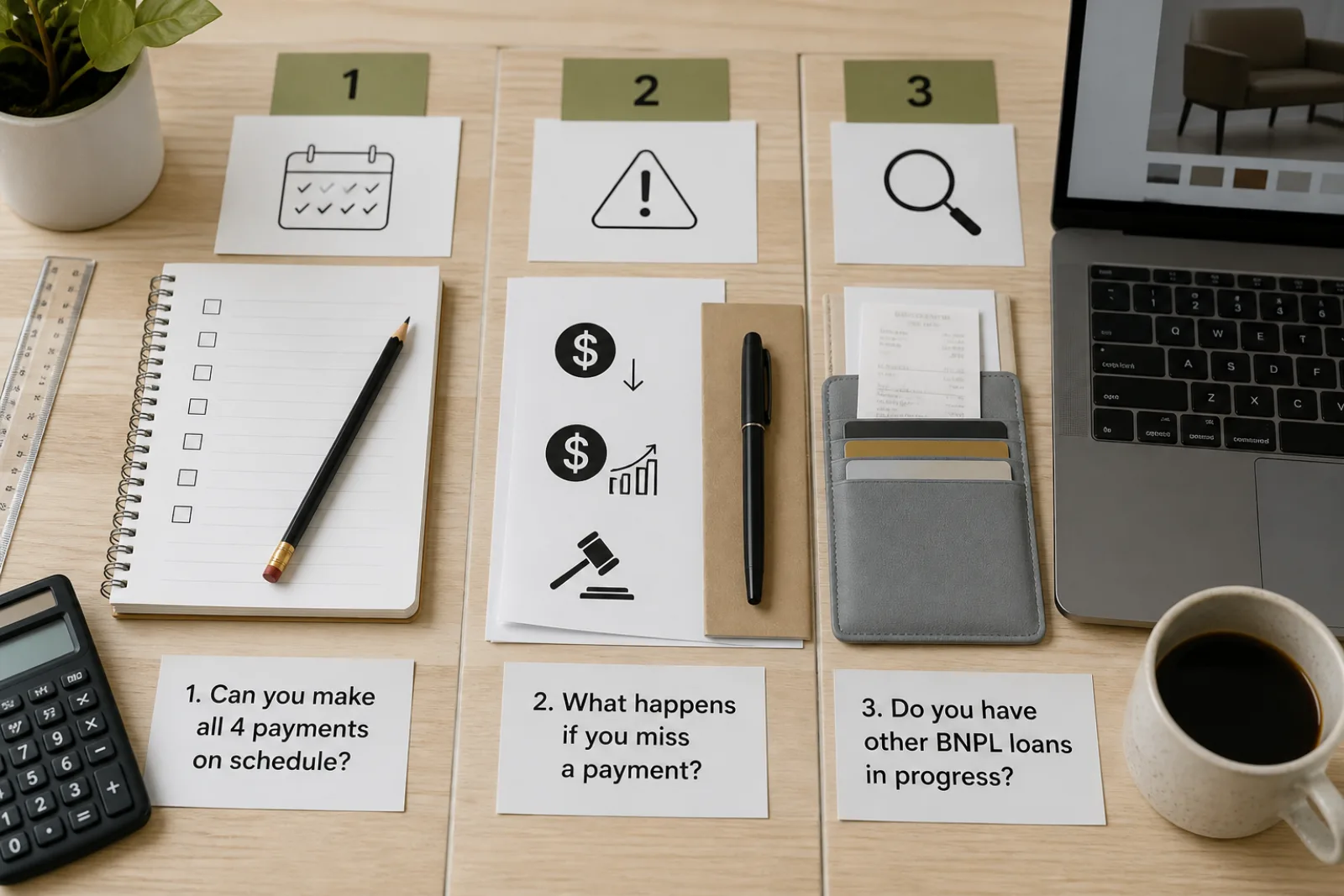
What to check before accepting a pay-in-four offer
- 01Map all four payment dates against your actual pay schedule
Write down the specific dates, not just "every two weeks." If a payment lands the same week as rent or another BNPL installment, that is a real conflict, not a hypothetical one.
- 02Read the missed-payment terms for this specific provider
Late fees, whether a missed payment is reported to credit bureaus, and whether it can be split further vary by BNPL company and are not standardized the way credit card terms are.
- 03Count your other open BNPL loans
Check your bank statement and email for other pay-in-four commitments, since a new provider often has no way to see loans you already have open elsewhere.
- 04Decide before checkout, not during it
The offer is designed to be accepted in the moment; deciding your limit in advance removes the pressure of a live checkout screen.
The third step is the one people skip most often, and it is the one the data says matters most. In its analysis of 145 million BNPL loan applications from 2017 through 2022, the CFPB found that 63 percent of borrowers had taken out more than one BNPL loan at the same time by 2022, and 33 percent were borrowing from more than one BNPL company simultaneously. Because BNPL loans have not been consistently reported to credit bureaus, a new lender approving your fourth loan of the month often has no visibility into the other three. Nothing stops the math from working against you quietly: four separate $100-a-month obligations do not look like much individually, but they add up to the same total pressure as one $400 loan, without ever appearing anywhere as a single number.
Before you accept a pay-in-four offer
- 01Write out the four exact payment dates and amounts
Not "every two weeks", the actual calendar dates.
- 02Check them against your pay schedule and other fixed bills
A payment due the same week as rent is a real scheduling conflict.
- 03Read this provider's specific late-payment policy
Fees, credit reporting, and grace periods differ by company.
- 04Total up any other BNPL loans you currently have open
A new lender usually cannot see these; you have to count them yourself.
- 05Confirm the refund process before buying
Returning an item does not always immediately stop or refund a BNPL payment schedule.
The short version
- 01
A BNPL offer is a real installment loan; evaluate it against your actual pay schedule and existing obligations, not just the advertised zero-interest headline.
- 02
A third of BNPL borrowers are juggling loans across multiple providers at once, a pattern that is easy to fall into precisely because no single lender can see the others.
- 03
Missed-payment terms and refund handling are not standardized across BNPL providers; check the specific company's policy before you need it, not after.
Questions
- 01Does using Buy Now, Pay Later affect my credit score?
It depends on the provider and whether the loan is reported to credit bureaus, which has been inconsistent across BNPL companies; a missed or defaulted payment is more likely to be reported and to hurt your score than on-time payments are to help it.
- 02What happens to my BNPL payments if I return the item?
This varies by provider. Some pause or cancel remaining payments once a return is processed by the merchant; others require you to continue paying and then get refunded separately. Check the specific provider's return policy before buying, since assuming a return automatically stops payments can leave you paying for an item you already sent back.