This article is about the cardboard sleeve, not the room. If you need to light a rental without adding hardwired fixtures, that is a layout problem: layers, aiming, and lamps you can take with you when the lease ends. The companion piece on improving lighting in a rental covers that. What this piece covers is the other half of the mistake, buying the wrong LED for a socket you already have, because the aisle still trains you to shop by watts.
Culture Column has not photometered any bulb, dimmer, or enclosed fixture. The numbers below come from the FTC Lighting Facts label rules, ENERGY STAR's lamp specification, and ENERGY STAR's consumer checklist. Rated life on a package is a standardized estimate under test conditions. It is not a warranty that a hot glass globe on a 1998 dimmer will last 22 years.
The FTC's consumer page is blunt: people used to shop by watts, but wattage only tells you how much energy a bulb uses. Lumens measure brightness. A traditional 60-watt incandescent made about 800 lumens. An LED can make those same 800 lumens on about 9 watts. Once you know the lumen number you want, the Lighting Facts label on the package is the comparison sheet: brightness in lumens, estimated yearly energy cost, expected life in years, light appearance (warm to cool), wattage, and whether the bulb contains mercury. LEDs do not contain mercury. Compact fluorescents do, which is why that line still exists on the label template.
ENERGY STAR's Light Bulb Purchasing Checklist is the decoder ring for people who still think in incandescent watts. To replace a 40-watt incandescent, look for at least 450 lumens. For 60 watts, 800 lumens. For 75 watts, 1,100 lumens. For 100 watts, 1,600 lumens. For 150 watts, 2,600 lumens. Those are minimum light-output targets on the checklist, not a promise that every 800-lumen LED will look identical in your shade. A dark, narrow shade eats lumens. A clear globe in a hallway does not. The lumen number is still the only brightness figure the federal label requires you to be shown.
These are ENERGY STAR checklist minimums for matching old incandescent brightness, not measurements of any specific LED on a shelf.
ENERGY STAR Light Bulb Purchasing Checklist · accessed 2026-08-12 · Values copied from ENERGY STAR's published purchasing checklist table of incandescent wattage versus minimum light output in lumens. Not independent photometric testing.
Read the Lighting Facts panel as a comparison sheet, not as the whole story. Brightness in lumens is the number to match. Estimated yearly energy cost is a modeled figure at a stated electricity price and hours of use, meant for comparing packages, not for predicting your bill. Life in years is a converted rated-life claim, usually assuming about three hours a day. Light appearance is Kelvin, warm to cool. Watts are input power. Mercury should read none on an LED. CRI, enclosed-fixture rating, and dimmer compatibility are not on that panel. They live in the rest of the fine print.
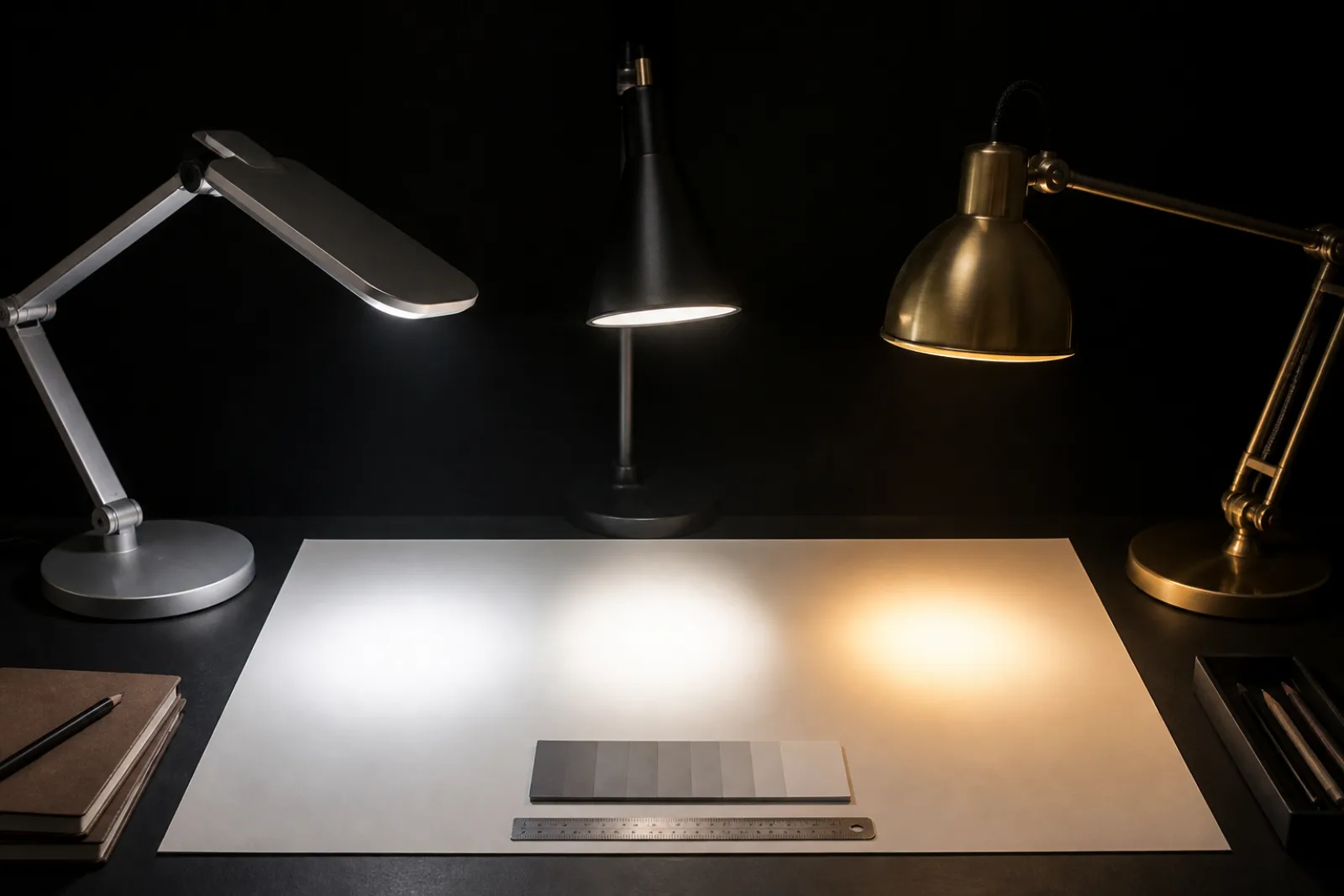
Color appearance and color accuracy are different quantities, and the aisle conflates them. Correlated color temperature (CCT), in kelvin, is what the Lighting Facts 'light appearance' bar shows. ENERGY STAR's checklist maps the common residential points: 2700K as warm white, the old incandescent color; 3000K as soft white; 3500K as a cooler white often used in kitchens and work spaces; then 4100K, 5000K, and 6500K toward daylight. Lower kelvin looks yellower. Higher kelvin looks whiter or bluer. That is appearance, the color of the light itself.
Color rendering index (CRI, reported as Ra) is how accurately that light reveals the colors of objects compared with a reference source. The Lighting Facts label does not have to print it. ENERGY STAR's lamps specification does: a solid-state lamp must have Ra of at least 80, with limits on how many sample units can fall below 77, and none below 75. The Department of Energy's purchasing page repeats the same floor: ENERGY STAR-qualified bulbs must have a CRI of 80 or greater. If you are matching paint, food, or skin in a bathroom, look for CRI 90 on the fine print or the manufacturer's spec sheet. If the package is silent, assume you are getting the ENERGY STAR minimum or less, not a studio lamp.
- CRI (Ra)
- ENERGY STAR solid-state lamps: Ra at least 80. Often printed only in small type or on a spec sheet. Higher (90+) is a color-accuracy claim, not a brightness claim.
- Dimmable
- ENERGY STAR defines a dimmable lamp as one that can reduce light output to 20% or lower with a suitable control while meeting the spec's dimming tests. The checklist says to look for a bulb marked Dimmable. Unmarked usually means do not put it on a dimmer.
- 3-way
- A three-way socket needs a bulb marked 3-Way. A standard LED will not step through low/medium/high on a three-way lamp.
- Enclosed or recessed use
- ENERGY STAR requires the package exterior to state application restrictions such as totally enclosed luminaires, recessed luminaires, ICAT downlights, and damp locations. DOE notes that enclosed fixtures trap heat and can shorten LED life if the bulb is not rated for that use.
- Shape and base
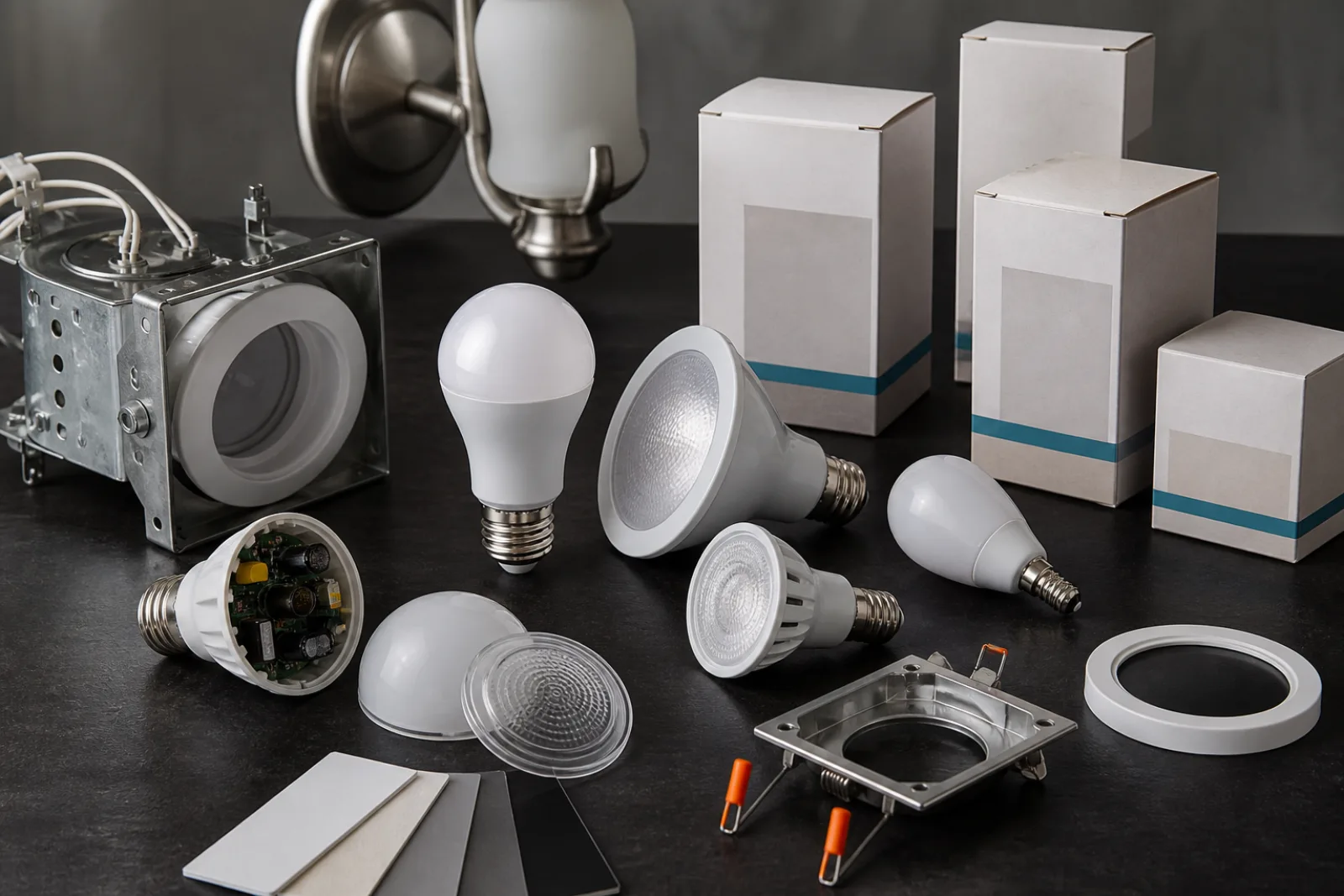
- A19 with E26 is the common household pear and medium screw. Candelabra (E12), globe (G25), and reflector (BR/PAR) shapes are not interchangeable with an A19 just because the lumens match.
ENERGY STAR Lamps V2.0 specification; ENERGY STAR Light Bulb Purchasing Checklist; DOE purchasing guidance. Accessed 2026-08-12.
Heat is why enclosed-fixture rating is not fine print. An LED's driver and diodes live in the same small envelope that used to be an empty glass bulb. A fully enclosed globe, a recessed can with a sealed trim, or an outdoor wall lantern with a glass door traps that heat. ENERGY STAR's specification treats 'not for use in totally enclosed luminaires' and 'not for use in recessed luminaires' as labeling that changes which tests apply. If the package does not say the bulb is rated for enclosed fixtures, do not put it in one and then blame the 15,000-hour claim when it dies in two years. The Department of Energy's purchasing guidance says the same thing in plainer language: when buying for fully enclosed fixtures, check the packaging or technical specifications.
Dimmers are a second compatibility problem, not a brightness problem. Incandescent dimmers chopped a resistive load. Many LED bulbs are a switching power supply. ENERGY STAR's checklist tells you to look for a bulb marked Dimmable, and the specification's definition of dimmable is operational: the lamp must be able to go down to 20% output or lower with a suitable control. 'Works with most dimmers' is advertising. A compatibility list on the manufacturer's site, naming the dimmer models they tested, is a specification. If your dimmer is a 1990s rotary designed for a 150-watt incandescent, even a marked-dimmable LED may flicker, drop out at the bottom of the travel, or buzz. The fix is sometimes a dimmer listed for LEDs, not a brighter bulb.
Rated life is the number people treat as a guarantee. ENERGY STAR's lamps specification sets floors: omnidirectional and decorative LED lamps must have a rated life of at least 15,000 hours; directional lamps at least 25,000 hours. Those hours are lumen-maintenance claims, commonly to L70, meaning the point at which the lamp is estimated to have fallen to 70% of initial output, based on standardized tests (including 6,000-hour lumen-maintenance data and, for longer claims, projections). The Lighting Facts 'life in years' line usually assumes about three hours of use per day. A 15,000-hour claim at three hours a day is about 13 years on paper. It is not a promise that a bulb in a sealed porch fixture, on a dimmer, in a 90-degree attic, will still be at 70% in 2039. ENERGY STAR also ties warranty length to the life rating (a 3-year minimum warranty for lamps rated 15,000 hours or more, based on three hours a day). Read the warranty. It is the only part of the life claim that is a commercial obligation.
Reading the package in order
Do you know the lumen number you want, or only the old wattage?
- 01Convert watts to lumens if needed
Use ENERGY STAR's stand-ins: 40W to 450 lm, 60W to 800, 75W to 1,100, 100W to 1,600. Then ignore watts except as an efficiency check.
- I have a lumen target
- 02Pick appearance in Kelvin
2700K to 3000K for rooms that used to have incandescents. 3500K to 4100K for kitchens and work. 5000K to 6500K only if you want a daylight look.
- CCT chosen
- 03Is the fixture enclosed, recessed, damp, or on a dimmer or 3-way socket?
These are binary package markings, not vibes. If the package is silent, treat the bulb as open-fixture, non-dimmable, indoor-dry.
- Open fixture, no dimmer, standard socket
- Enclosed, recessed, damp, dimmer, or 3-wayOnly buy a bulb whose package explicitly allows that use: enclosed-rated, damp-rated, marked Dimmable, or marked 3-Way. Shape and base still have to match.
- 04Do you care how colors look?
ENERGY STAR's floor is CRI 80. Bathrooms, kitchens, and anywhere you match colors benefit from CRI 90 if the package or spec sheet lists it.
- CRI 80 is enough, or CRI 90 is printedBuy that bulb. Treat rated life as an estimate, keep the receipt for the warranty, and do not mix 2700K and 5000K in the same visual field unless you like the clash.
Before you buy
- 01
Match lumens (450/800/1,100/1,600) and Kelvin first. Watts are the efficiency leftover.
- 02
Look past Lighting Facts for CRI, the word Dimmable, and enclosed-fixture language. Those decide whether the bulb survives the fixture you already own.
- 03
Treat years-of-life on the label as a test-condition estimate. The warranty is the part you can actually use.
Questions
- 01Why does an 800-lumen LED look dimmer than the 60-watt incandescent I remember?
Direction and shade. An omnidirectional A19 in a dark fabric shade delivers fewer lumens to the room than a bare incandescent did. The lumen rating is total output, not illuminance on your table. Try a higher lumen target, a lighter shade, or a separate lamp rather than assuming the label is lying.
- 02Is ENERGY STAR required?
No. It is a voluntary EPA/DOE program. The FTC Lighting Facts label is the mandatory comparison panel for covered general-service lamps. ENERGY STAR is the extra performance floor (CRI, life, dimming tests, labeling of restrictions).
- 03Can I put any LED in an enclosed porch light?
Only if the package says it is rated for enclosed fixtures (and for damp or wet locations if the fixture is outdoors). Heat, not rain, is the usual indoor-enclosed failure. DOE and ENERGY STAR both treat that restriction as a real application limit.