Most small entryways don't fail because they're small. They fail because one surface is doing three different jobs: catching what comes in, hiding it from view, and holding what needs to go back out. A console table can't do all three at once, so it ends up buried under mail, a stray shoe, and a phone charger by Wednesday.
Before buying anything, measure two things: the width of the space, wall to wall, and the arc of the front door as it swings open. A standard interior door is 30 to 36 inches wide, and it needs that much clearance to open fully. Anything placed inside that arc, a bench, a table leg, a shoe rack, will get hit by the door or block it from opening all the way. That measurement, more than any product list, decides what will actually fit.
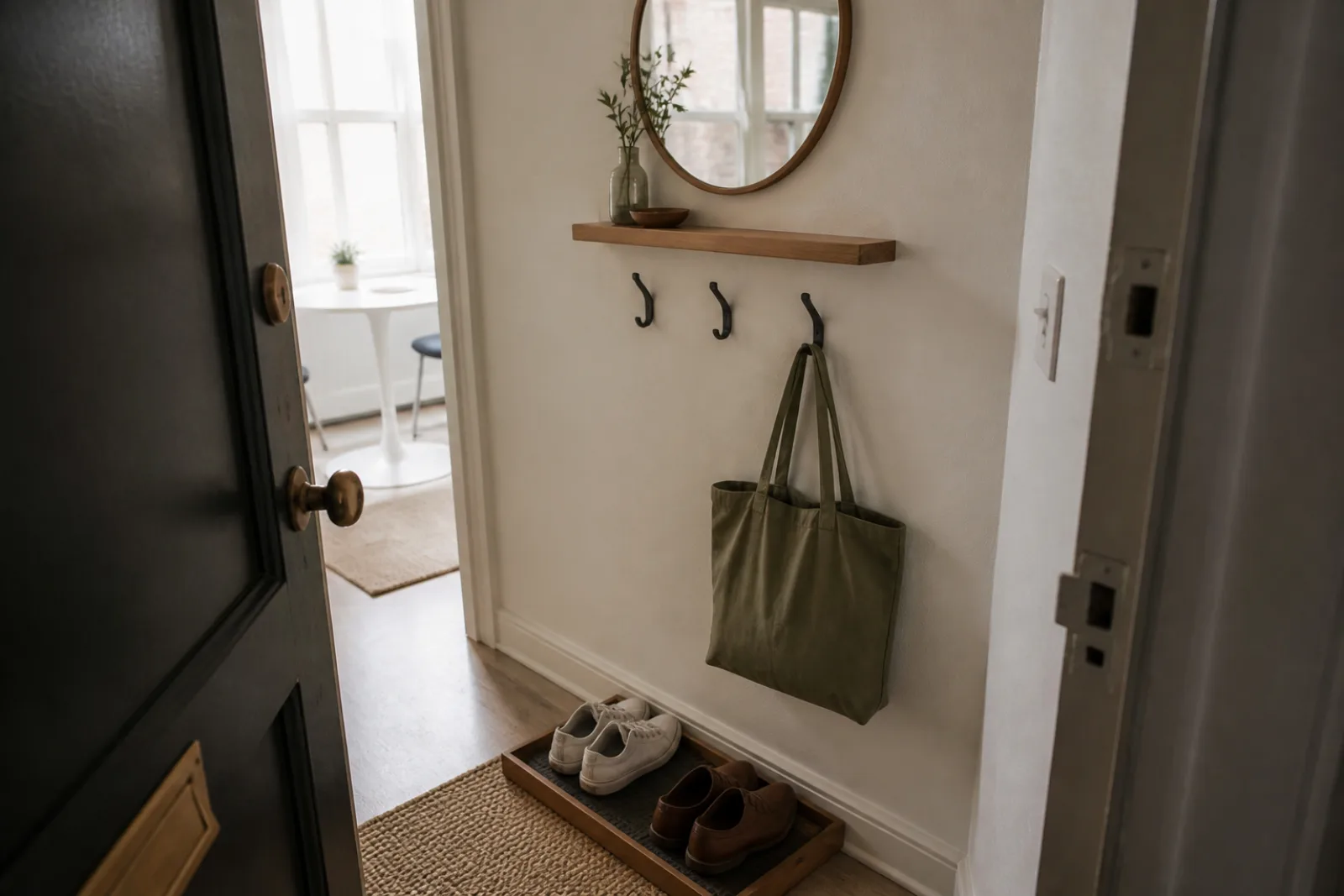
The landing surface is whatever sits closest to the door: a console table, a wall-mounted shelf, or a shallow bench top. In a hallway narrower than 42 inches, skip the table and use a floating shelf instead; something 9 to 10 inches deep won't block foot traffic the way a 16-inch-deep table will. Mount it around 40 to 42 inches high, roughly hip to chest height for most adults, so keys and mail land there without anyone bending down. Put a small tray or bowl on it reserved only for keys, and let nothing else migrate into that tray. A wall-mounted mail sorter, most run 10 to 16 inches wide and 3 to 4 inches deep, keeps incoming mail from spreading across the rest of the surface.
Shoes are the item most likely to end up in a pile on the floor, so they need a closed container, not an open rack. A storage bench with a lift-top or flip-front doors, 36 to 48 inches long and about 18 inches high at the seat, seats one or two people while hiding four to eight pairs underneath. If the entry is too narrow for a bench (under 30 inches of clear wall), a slim shoe cabinet 12 to 16 inches deep does the same job standing flat against the wall instead of jutting into the walkway.
Coats and bags need vertical space, not floor space. Mount hooks at two heights: about 60 to 66 inches for adults, and 40 to 46 inches for kids, so nobody has to hang a coat above their own head. Four to six hooks is usually enough for a household of two to four people; more than that and hooks tend to become a dumping ground instead of a system.
Setting Up the System, Step by Step
- 01Measure the space
Note the wall-to-wall width and the door's swing arc (usually 30-36 inches) before choosing any furniture.
- 02Place the landing surface
Console table, floating shelf, or bench top, positioned outside the door's swing.
- 03Add closed storage below or beside it
A lidded bench or slim cabinet for shoes, sized to the available floor width.
- 04Mount hooks at two heights
Adult height (60-66 in) and kid height (40-46 in) if children use the entry regularly.
- 05Set up one outgoing spot
A separate basket or hook for what's leaving: outgoing mail, library books, dry cleaning.
- 06Run it for a week, then adjust
Notice what still doesn't have a home and give it one before adding more furniture.
An entryway that only handles incoming stuff will still generate piles, because outgoing items, mail to send, a library book due back, a return to drop off, have nowhere to wait. Give them a container separate from the incoming tray: a second basket, a canvas bag on its own hook, or a lower shelf on the console table. The point is physical separation. If outgoing mail sits in the same bowl as incoming mail, it gets reopened, re-sorted, and eventually forgotten. A basket by the door reserved only for what needs to leave gets grabbed automatically on the way out, without anyone having to think about it.
Small Entryway Setup Checklist
- 01Measured wall width and door swing arc
Do this before shopping, not after
- 02Landing surface no deeper than 12 inches if the hallway is under 42 inches wide
- 03One tray or bowl reserved only for keys
- 04Closed shoe storage: a bench (36-48 in) or a slim cabinet (12-16 in deep)
- 05Hooks mounted at two heights if kids use the entry
- 06Separate container for outgoing mail and errands, apart from the incoming tray
- 07Landing surface emptied completely once a week
Questions
- 01What if there's no coat closet at all?
Hooks and a bench do the job a closet would. Four to six wall hooks at two heights, plus a lidded bench for shoes, replace a closet in about four feet of wall space.
- 02The hallway is only 24 inches wide. What actually fits?
Skip freestanding furniture. A floating shelf 6 to 8 inches deep, two or three hooks, and a slim over-the-door shoe organizer on the nearest closet door hold the basics without narrowing the walkway further.
- 03What if the front door opens directly into the living room, with no separate entry at all?
Treat the nearest three to four feet of wall, wherever the door opens toward, as the entry zone and apply the same three zones there. A narrow console or shelf just inside the door line, positioned so it doesn't interrupt the door's swing, works the same way a dedicated foyer would.
The Short Version
- 01
Split the entry into three zones: a landing surface for what comes in, closed storage for shoes and bags, and a separate spot for what's going back out.
- 02
Measure the door's swing arc (usually 30-36 inches) before buying furniture; it determines what will actually fit without blocking the door.
- 03
Keep incoming and outgoing mail physically separate, or outgoing items will never leave the house.